Photo credit: Ecoclean
To ensure that products meet today’s rising demands on reliability and performance, highly clean surfaces are a prerequisite in numerous industries. These cleanliness levels required for stable product quality cannot usually be achieved with conventional cleaning systems. As an experienced provider of solutions for precision and high-purity cleaning, Ecoclean is consistently driving forward the development of cleaning systems, methods and processes for this sector, including specially designed equipment packages.
The manufacture of high-end components is today usually associated with extremely high and still rising demands on technical cleanliness, for example in the semiconductor supply industry, optical and optoelectronic industry, thin-film and coating technology, vacuum, aerospace, laser and analysis technology as well as medical technology. Although the specifications vary depending on the product, area of application and company. In some cases, extreme limit values must be met in terms of particulate, film-like, organic and inorganic contamination as well as outgassing behavior in a vacuum. At the same time, the variety of materials and part dimensions are increasing.
Needs-based definition of cleanliness
For component cleaning, this results in challenging tasks that extend across the entire production process. The definition of particulate cleanliness specifications, which for precision and high-purity applications go down to the nanometer range, is usually carried out by specifying the surface cleanliness class. The specifications for the required film-chemical, organic, and inorganic surface cleanliness are usually defined by individual specifications or factory standards, for example outgassing rates, which are evaluated using mass spectrometers. To solve these tasks efficiently and sustainably in line with requirements, comprehensive technological expertise as well as knowledge of the applications and physical relationships are required. As an experienced full-service provider of future-oriented solutions for precision and high-purity cleaning, Ecoclean has both. This guarantees cleaning solutions designed to meet requirements and equipped with which defined cleanliness specifications up to the highest current requirements (e.g., Grade 1) can be stably achieved.
Selecting the right cleaning process and system technology
The key criteria for selecting the most suitable cleaning process and system technology are the cleanliness to be achieved, the contamination to be removed and the material and geometry of the component. On this basis, it is possible to determine which and how many process steps are required with which cleaning medium and which mechanics. Aspects such as the quality of the rinsing medium and the drying technology are included in this consideration, as well as the cleanliness-compliant parts handling and the environmental conditions, for example connection or integration into a cleanroom.
If the "oil and grease-free" standard, for example grade 4, is defined as the specification, cost-efficient and compact full-vacuum single-chamber systems are available whose system technology, media routing and preparation as well as design have been specially adapted for high-end cleaning applications. With these systems, which are operated with environmentally friendly solvents or water-based cleaning agents, a stable result that meets the requirements can be achieved even with geometrically complex components. Process options that can be combined in almost any way, such as injection flood washing, spray, high-pressure, immersion, ultrasonic or megasonic and plasma cleaning as well as Ultrasonic Plus or Pulsated Pressure Cleaning (PPC), contribute to this. A modified alcohol (partially polar solvent) is often used in these applications due to the media-related advantages, such as the ability to clean different materials. Depending on the process chain, task, design and equipment of the system, even high requirements, such as Grade 2, can be reliably achieved.
Especially for large parts, chamber cleaning systems offer advantages due to the concentrated process mechanics in the working chamber, for example PPC, ultrasonic or megasonic and injection flood guards. Ecoclean manufactures the EcoCvela chamber systems for cleaning with water-based media to be able to use these with the appropriate cleanliness specifications. In addition to the special high-purity equipment, separate media circuits for cleaning and rinsing ensure that the defined cleaning result is achieved reliably and repetitively. Even the highest purity requirements can be achieved with aqueous double or multi-chamber systems.
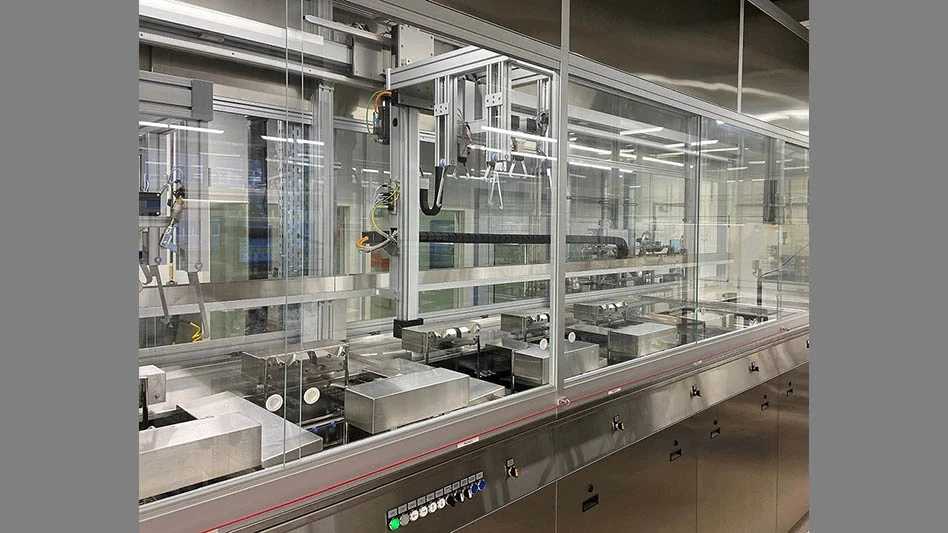
However, if, in addition to very high cleanliness requirements, there are also very high throughput requirements, a multi-bath ultrasonic cleaning system is often used. The SBS Ecoclean Group also offers efficient solutions in this area with the UCMSmartLine, UCMPrimeLine or UCMPerformanceLine series of standardized modules. Thanks to the electrical and control technology integrated into the modules for the cleaning, rinsing, drying, loading, and unloading process steps as well as the equipment with a flexible transport system, they can be easily adapted to the respective task and expanded as required. Individually designed multi-bath ultrasonic cleaning systems such as the UCMHighLine are usually used for high-end applications, for example in the semiconductor supply industry, laser, and optical industry.
Process development and design in the Test Center
Which system concept is the right one in terms of cleanliness and cost-effectiveness is determined through cleaning tests with original components or test coupons. Ecoclean has appropriate High Purity Test Centers for this purpose. This enables the product-specific development of cleaning processes and process parameters, which can be saved as programs in the system control. This ensures that each part is treated with the validated process parameters and that the required purity is achieved in a stable and reproducible manner. In addition, all relevant process parameters can be monitored, documented, and transferred to higher-level systems.