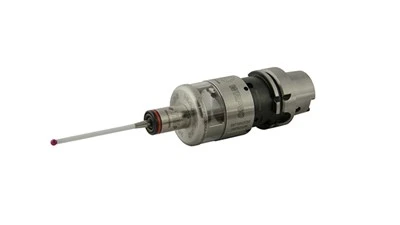
Auburn Hills, Michigan – The Marposs WRP60P and WRP45P high-accuracy touch probes with multi-channel radio transmission are now available. These probes are designed for high accuracy 5-axis machining centers and milling machines, which address high precision industries such as die and mold, aerospace, aeronautics, and biomedical.
Through automatic detection of machine axis position, the WRP45P and WRP60P achieve part positioning, workpiece orientation, and origin identification as well as accurate part measurement. Based on piezo-electric technology, these probes provide excellent measurement performance on 3D surfaces with repeatability within 0.25µm. The WRP45P and WRP60P go beyond other high precision probes, which might be sensitive to noise and vibrations, and by relying on a special filter, can distinguish false-triggering events from actual touch events.
These high-precision probes, which operate with the WRI receiver, have a range of 15m. And, since the line of sight between the touch probe transmitter and receiver is not required, complex surfaces and deep cavity parts can be inspected. Measurements may be performed at depths as great as 1 meter due to the modular structure and extensions of the probe.
There are several types of applications are available. The multi-channel transmission and option to choose the proper channel enables each application to support up to four probes, all managed by the same WRI receiver. Additionally, the probes used in conjunction with the WRTS tool setting system can be used for twin applications allowing users to check the part and the tool using the same WRI receiver. Multi-spindle applications can also be achieved by installing two applications on the same machine, enabling two probes to be used simultaneously.
Mida Diamond family
The WRP45P and WRP60P are part of the Mida Diamond line of high precision machine tool touch probes and tool setters designed to control every step of the production process. Advantages of the Mida Diamond probing line include reduced machining and checking times, increased production efficiency, reduced production rejects, and constant machining quality level during the entire production process.