PHOTO COURTESY FIXTUREWORKS
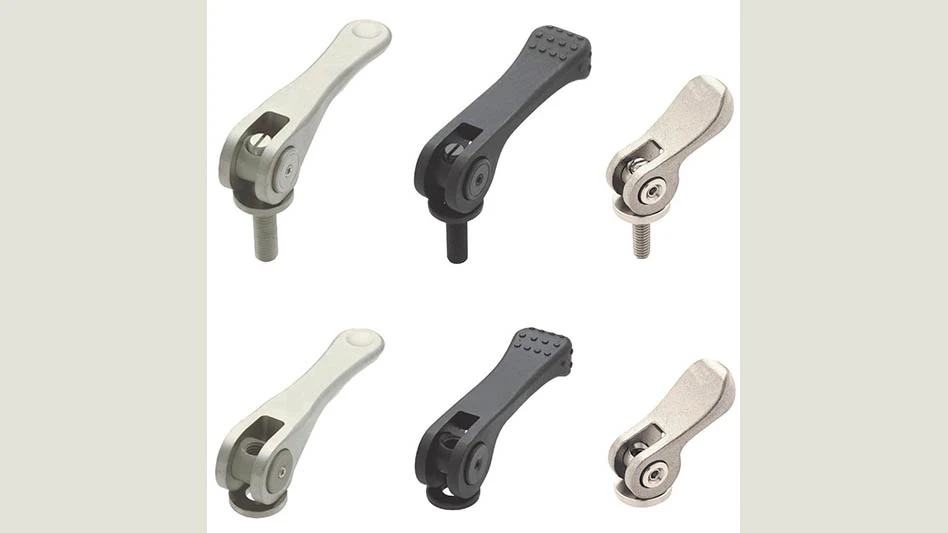
Fixtureworks, a supplier of workholding and fixturing technologies, has augmented its clamp lineup with the addition of new cam levers, the QLCL, QLCCS, and the QLCA in addition to its existing lineup. Cam levers are for fast cycle time operations requiring quick loading, securing and unloading. They are designed to provide ergonomic clamping function of part fixtures and optimum process productivity. The levers are outfitted with either internal female threads or complete with male threaded studs for attaching to fixture bases, plates, tombstones, machine tables, or other workholding elements.
The cam levers from Fixtureworks are offered in a variety of sizes: inch (6-32, 5/16-18) and metric (M4, M5, M6 & M8) internal threads, plus inch (10-32, 1/4-20, 5/16-18, & 3/8-16) and metric (M5, M6, M8 & M10) external threaded selections.
Compared to conventional cam handles, QLCL levers have a higher resistance against vibration and feature a noticeable click feel at clamping end. Additionally, the handle position of the stud-type version can be set to any desired direction. The QLCCS with either a stud or tapped version is a stainless-steel cam lever version. With its compact design, it is especially easy for clamping and unclamping. The QLCA has also stud or tapped version, but in a black oxide finish.
Fixtureworks cam lever handles are constructed from cast aluminum, stainless steel, steel with black oxide finish, or plastic; a setscrew and internal pad are included to help prevent the levers from backing off and loosening during operation. The variety of cam levers include compact, heavy duty, quick lock, expansion types and more.
Once the preliminary assembly and tightening of the threaded elements is completed (like traditional clamping fasteners), the cam action handles allow for quick final clamping or unclamping without the use of tools. The cam lever is simply pushed downward with only minimal hand force, while still generating clamping force as high as 1,200 lb. depending upon the size range of the lever.
To unfasten, the handle is pulled up which releases the clamping pressure, allowing the part to be removed for fast part unloading and loading of the next piece.