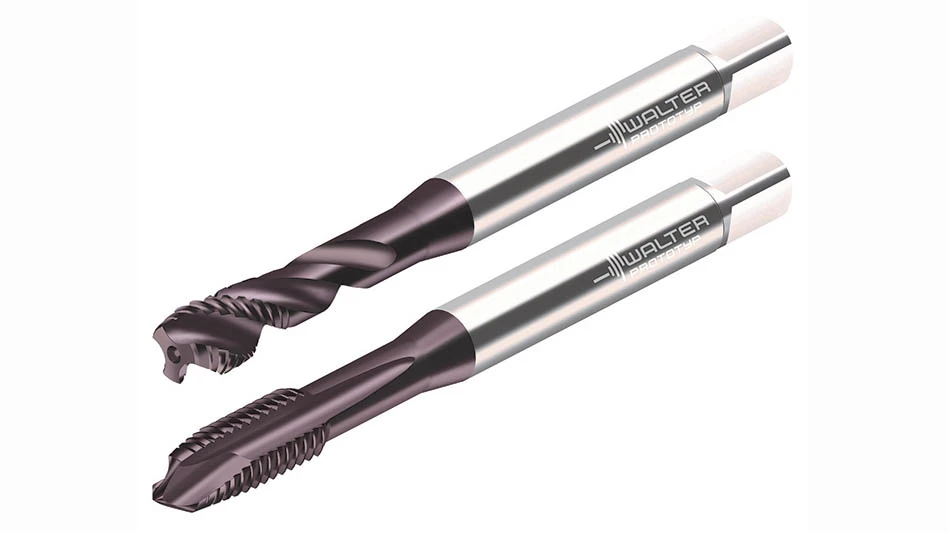
Photo credit: Walter USA
Walter has expanded the range of its Thread·tec Omni TD117 Advance blind-hole tap and Thread·tec Omni TD217 Advance through-hole tap. The new additions to the TD117 Advance blind-hole tap include DIN profiles of G, UNC, UNF and UN-8, EgUNC and EgUNF screw thread inserts, as well as the DIN/ANSI profiles of UNC, UNF and UN-8, STI-UNC and STI-UNF screw thread inserts.
The new additions to the TD217 Advance through-hole tap include the DIN profiles G, BSW, UNC, UNF and UNEF, EgUNC and EgUNF screw thread inserts, as well as the DIN/ANSI profiles UNC and UNF, STI-UNC and STI-UNF screw thread inserts.
Both the TD117 and TD217 taps feature a wear-resistant HSS-E substrate and are available in three grades: WY80FC, WY80RG, and WY80AA. WY80FC is a universal steam-oxide coated grade and enables excellent chip formation. WY80RG is a high-performance coated grade for optimum threading of stainless steel and non-ferrous metals (ISO M and N material groups). WY80AA is the first-choice advanced-TiN coated grade for tapping steel and cast iron (ISO P and K material groups).
The TD117 tap has a 40° helix angle for the best possible removal of chips from blind-hole threads. An optimized cutting edge preparation enables reliable thread production, and a special micro-geometry on the edge prevents fractures.
The tool is available in various tolerance levels and can produce the C and E variants of chamfer forms. An extra-long variant is also offered.
The versatile TD117 tap can generate blind-hole threads up to 2.5x the diameter nominal (DN) and is suitable for general mechanical engineering applications.
The reliable TD217 tap can generate through-hole threads up to 3x DN and is suitable for general mechanical engineering applications. The tool offers an enhanced tolerance position to extend tool life for all dimensions and profiles. An enhanced spiral point angle increases performance and chip control.