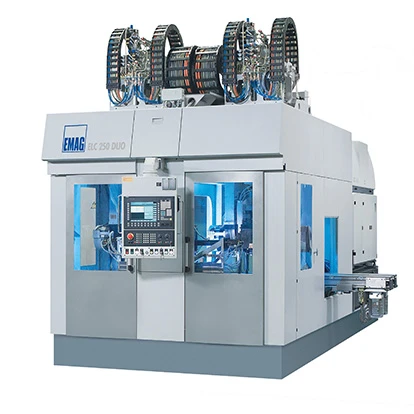
Farmington Hills, Michigan - Whether hybrids, fully electric vehicles or power units with fuel cells, the future of mobility is far from clear and remains exciting. The one thing that is certain, however, is that changes will come for which the industry will have to find flexible solutions. In addition to these new, big ideas, many small changes are taking place that also have a major influence on the success of new products. Classic components, such as differential gearboxes, will continue to be manufactured in the future regardless of the type of energy that powers the vehicle. EMAG provides manufacturing solutions for the entire differential gearbox, with the particular highlight the laser welding systems for differential housings and ring gears based on the EMAG ELC 250 DUO Laser Cell.
Check out the 2016 IMTS Conference!
When talking about optimizing the production of gearbox components, there are two main aspects to speak of, on the one hand optimizing the component itself, for example in terms of quality and weight, and on the other, improving the production process to reduce component costs. With regard to laser welding technology in general, and the ELC 250 DUO laser welding machine in particular, major benefits can be generated in both areas.
The challenge: connecting the ring gear and differential housing
There are two unbeatable arguments in favor of substituting the classic screw connection between a ring gear and differential housing that are sure to capture the attention of any manufacturer of axle transmissions: reducing weight and cost. The weight saving for a welded differential in a car engine is around 0.6 to 1.2 kg, a clear cost savings considering the reduced material consumption, the elimination of machining and the assembly for the high-strength screws required.
So what special requirements are in focus? First of all, a range of different materials are used. While the differential housing is made of a cast material, the ring gear is made of case-hardened steel. As a result of the material hardness, welding cast is always a critical process and it is essential it be tailored to the specific component. There are no “off-the-rack solutions.” Another challenge is the pre-assembly of the differential gearbox housing. Contamination from previous production processes (oil, assembly pastes, etc.) can adversely affect the welding process, resulting in cracks in the weld. Cleaning the welding zone is therefore crucial, also for the ring gear generally surface-treated by phosphating that can also adversely affect the welding process and must be cleaned.
The ELC 250 DUO – the heart of the process
EMAG Automation has already supplied more than 20 complete systems for the joining and laser welding of differential gearboxes – each of them perfectly tailored to the customer and their level of automation, flexibility, layout and process. The heart of every system is the ELC 250 DUO laser welding machine, also developed and manufactured by EMAG Automation. When you first see the ELC 250 DUO, you immediately notice the two machining areas. The twin-spindle design is consistent with the goal of the entire system to achieve maximum productivity. To this end the ELC 250 DUO uses the typical EMAG pick-up principle of self-loading working spindles. There are several benefits to using pick-up spindles: this principle allows fixed lenses to be used since the workpiece moves rather than the tool, and it allows loading and unloading to take place during the cycle time so as to reduce idle times. The benefits resulting from the fixed lenses cannot be underestimated in terms of safety. The fact that the lenses are fixed means that the laser is always directed into the inside of the machine, thus guaranteeing an excellent level of protection for the user. Furthermore, fixed lenses ensure perfect process reliability since all the laser technology and logistics for operating the laser must only be set up once and do not need to be changed again.
The advantages are clear: Operational safety and ease of servicing.
The optical system is extremely simple yet robust. Using their expertise in machine tool manufacturing, EMAG has managed to create a high precision, heavy-duty production solution, as our users continually confirm. This provides the perfect platform for reliable large series production. The optimized beam control and targeted extraction protect the lenses from contamination during the welding process. And while we are on the subject of lasers, the ELC 250 DUO can, of course, be equipped with the very latest laser technology to suit component requirements and the customer’s specifications. Mentionable is also that although the process takes place on two stations within the ELC 250 DUO, only one laser source is required. A beam deflector is used to switch the laser between the focusing lenses at the two welding stations. This improves the usage of the laser and increases the productivity of the laser welding system.
Source: EMAG LLC