Photo credit: SCHURTER Inc.
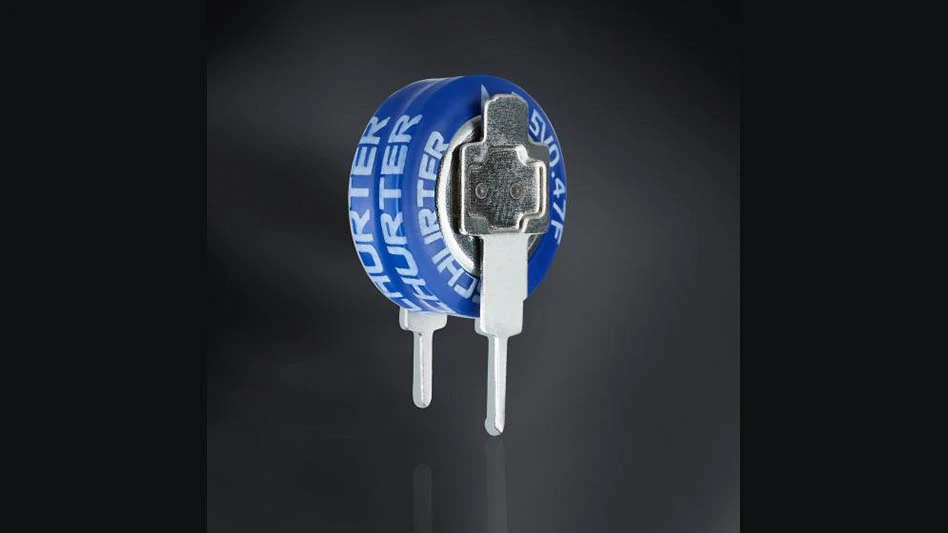
Coin cell supercapacitors are compact electrochemical energy storage devices with a high capacity that can quickly store and release electrical energy. Compared to conventional batteries, they offer several advantages, including high power density, a long cycle life, and fast charge and discharge rates.
Supercapacitors have around 10% of the energy density of rechargeable batteries of the same weight. However, their power density is 10x to 100x greater. Supercapacitors can therefore be charged and discharged much faster. They can also withstand many more charging cycles than rechargeable batteries, making them suitable as a replacement or supplement wherever high switching loads are required.
Power density vs energy density
Power density describes how quickly an energy storage device can release or absorb energy. This is important for applications requiring short-term high energy outputs, such as starting an engine. Supercapacitors have a high-power density, which enables them to provide energy quickly. Energy density indicates how much energy a storage device can hold over a longer period. A high energy density is essential for applications requiring a continuous energy supply.
The new coin cell supercapacitors are used in a variety of applications, including backup power supplies, electronic devices, renewable energy systems, and medical devices. While they are most used for real-time clock backup, they can also be used for memory backup, battery swap ride-through, and LED or audible alarms. The new coin cell supercapacitors from SCHURTER are available for horizontal mounting (SCCA) or vertical mounting (SCCC). They can be used in systems with a voltage of up to 5.5V and have a capacitance value ranging from 100mF to 1,500mF. The Coin Cell Super Capacitors and other SCHURTER products are supported through our franchised distributors.
Key features:
- Very compact design
- High power density
- Low leakage current
- Long lifetime
For product information, review the Datasheet or Landing page.