PHOTO COURTESY VENUS AEROSPACE
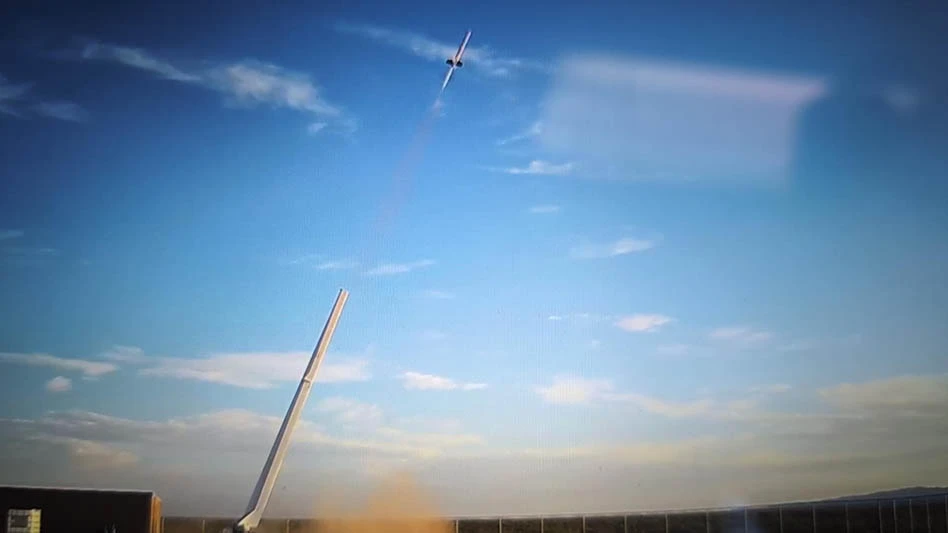
Houston, Texas-based startup Venus Aerospace successfully completed the first U.S. flight test of a rotating detonation rocket engine (RDRE). This milestone marks a breakthrough in American aerospace, with a design ultimately aimed at enabling vehicles to travel 4x to 6x the speed of sound from a conventional runway.
Theorized since the 1980s, a high-thrust RDRE capable of practical application has never been flown in the United States and possibly anywhere in the world. The test represents the first-ever flight of an American-developed engine of its kind, proving that Venus's proprietary RDRE compact propulsion system can operate under real-world conditions.
"This is the moment we've been working toward for five years," said Sassie Duggleby, CEO and co-founder of Venus Aerospace. "We've proven that this technology works, not just in simulations or the lab, but in the air. With this milestone, we're one step closer to making high-speed flight accessible, affordable, and sustainable."
The demonstration took place at Spaceport America in New Mexico, following a night of heavy winds. On the first attempt, Venus's RDRE successfully launched and flew its engine, validating performance and system integrity under flight conditions.
"Spaceport America was created to make space history, and Venus Aerospace delivered a milestone moment for hypersonics today," said Scott McLaughlin, executive director, Spaceport America. "Getting a rotating detonation rocket engine to the launch pad is an achievement few thought possible in such a short time. We're thrilled to host innovators like Venus, whose breakthroughs are redefining what's possible in spaceflight."
Compared to traditional rocket engines, RDREs offer improved efficiency and compactness, making them particularly suited for advanced aerospace applications. Venus's engine is designed to be affordable and scalable for both defense and commercial systems, including future vehicles that could fly passengers from Los Angeles to Tokyo in under two hours.
"This milestone is a testament to what's possible when engineering rigor meets entrepreneurial urgency," said Dr. Rodney Bowersox, associate dean for research and Professor of Aerospace Engineering, Texas A&M University. "Rotating detonation rocket engines have been a scientific curiosity for decades. Venus is showing the world that they aren't just academically interesting, they're buildable, testable, and operational under real-world conditions. This is how aerospace innovation should look."
Venus's RDRE is also engineered to work with the company's exclusive VDR2 air-breathing detonation ramjet. This pairing enables aircraft to take off from a runway and transition to speeds exceeding Mach 6, maintaining hypersonic cruise without the need for rocket boosters. Venus is planning full-scale propulsion testing and vehicle integration of this system, moving toward their ultimate goal: the Stargazer M4, a Mach 4 reusable passenger aircraft.
"This milestone proves our engine works outside the lab, under real flight conditions," added Andrew Duggleby, co-founder and chief technology officer. "Rotating detonation has been a long-sought gain in performance. Venus' RDRE solved the last but critical steps to harness the theoretical benefits of pressure gain combustion. We've built an engine that not only runs, but runs reliably and efficiently – and that's what makes it scalable. This is the foundation we need that, combined with a ramjet, completes the system from take-off to sustained hypersonic flight."
Venus is backed by top-tier investors including Airbus Ventures, Trousdale Ventures, America's Frontier Fund, and Prime Movers Lab, and supported by NASA and the United States Air Force.
Latest from Aerospace Manufacturing and Design
- OMA and NIMS partner to launch semiconductor technician credentials
- Analysis, trends, and forecasts for the future of additive manufacturing
- BlueForge Alliance Webinar Series Part III: Integrate Nationally, Catalyze Locally
- Blaser Swisslube, NIDEC Machine Tool America partner
- Extrusion crosshead combines concentricity adjustment, fastener-free assembly
- Vertical Aerospace unveils Valo eVTOL aircraft
- 3xD pilot step drill
- #56 Lunch + Learn Podcast with Techman Robot + AMET Inc.