McKinsey & Co.
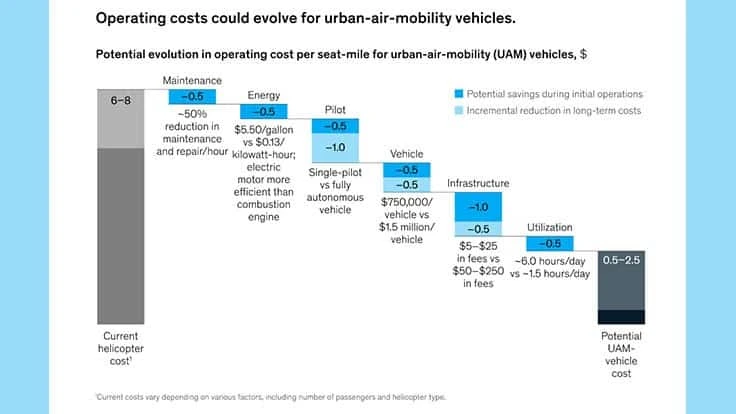
For congested cities, urban air mobility (UAM) vehicles could be a promising alternative to ground transportation. But to be successful, these vehicles need to cost 80% less to operate than helicopters currently do, according to analysts at business consulting firm McKinsey & Co. The accompanying chart shows the cost reductions per seat mile necessary for UAM vehicles to reach parity with current helicopters.
The dream of using new technologies to rise above the ever-increasing urban-road congestion has gained significant momentum, with more than 250 businesses planning to build, operate, or manufacture UAM vehicles. A growing assortment of industry players is working across the value chain to make this dream a reality. Enabled by vertical-takeoff and -landing (VTOL) systems, electric propulsion, and advanced flight-control capabilities, these vehicles could eventually reach price points rivaling today’s taxi services.
Click here to continue reading about the McKinsey & Co. experts’ insights on what UAMs will need to be economically viable.
Latest from Aerospace Manufacturing and Design
- Archer to test Starlink onboard its Midnight air taxis
- System eliminates cage-creep in sliding bearings
- Bodo Möller Chemie signs worldwide supply contract with Airbus
- Sandvik Coromant's CoroTurn Plus turning adapter
- ZOLLER Technology Days & Smart Manufacturing Summit May 13-14, 2026 in Ann Arbor, Michigan
- Walter's TC620 Supreme multi-row thread mill family
- ThermOmegaTech achieves CMMC Level 2 C3PAO certification
- One-touch precision flex locators