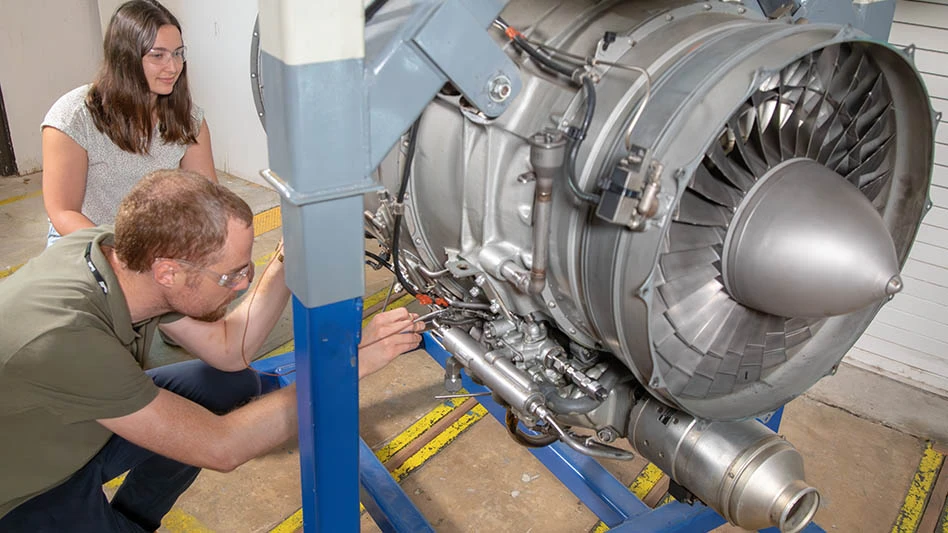
Photo courtesy Southwest Research Institute
Southwest Research Institute, an independent, nonprofit, applied research and development organization based in San Antonio, Texas, produced a batch of blended sustainable aviation fuel (SAF) through a refinery process that started with electrofuels (e-fuels) made from carbon dioxide and green hydrogen. Conventional jet fuel is made from petroleum.
Using internal research funding, a multidisciplinary team produced and characterized the SAF, along with two other commercially available fuels, before collecting emissions and particulate data to support the aviation industry’s emissions goals.
Fueling jets with SAF could help reduce carbon emissions. Worldwide air travel accounts for 2% of all carbon emissions, and 12% of all carbon emissions from transportation.
“Aviation is difficult to decarbonize due to the fuel density and power required for flight,” said Francesco Di Sabatino, a group leader in SwRI’s Mechanical Engineering Division. “With this project we’re gathering important data for conventional fuel and two different SAFs.”
The team tackled three focus areas – production, characterization, and testing.
First, chemical engineers refined e-fuels manufactured with hydrogen produced from electrolysis of water and captured carbon dioxide or carbon monoxide. The team then processed that into an in-house SAF meeting aviation fuels standards. Then SwRI’s fuels and lubricants specialists characterized the in-house SAF and compared it with traditional jet fuel and a commercially available SAF blend. SwRI's propulsion and energy specialists used a jet engine test stand to collect emissions data.
Through a series of hydroprocessing reactions throughout several weeks, process engineers refined the e-fuel into SAF to meet federal specifications. They engineered a small batch – about one barrel of fuel – to characterize and test fuels prior to commercialization.
“All jet fuels, including SAFs, must meet ASTM quality and safety standards, along with emissions guidelines set by the EPA, but conducting a full-scale jet engine test requires millions of dollars and hundreds of thousands of gallons of fuel,” Hsiang Yee Hoekstra, a manager in SwRI’s Chemical Engineering Department said. “By creating, characterizing, and measuring emissions for SAFs in small batches, we lower development costs, time, and risks for our clients.”
“We are excited to offer multidisciplinary solutions across all stages of the SAF development cycle,” said SwRI’s Executive Vice President Walt Downing. “This integrated project paired chemical and mechanical engineers with fluids and emissions experts to address several technical challenges.”
Di Sabatino will present at the Sustainable Aviation Futures Congress in Houston, October 14-16, 2025.
Southwest Research Institute (SwRI) is a leader in propulsion, aircraft technology, alternative fuels, and emissions characterization. In 2024, the Institute invested more than $11 million into its internal research and development program aimed at advancing new technology without the narrow scope and expected deliverables of contract R&D.
Latest from Aerospace Manufacturing and Design
- Dassault Aviation unveils the Falcon 10X
- Industrial round bumpers
- Defense Industry Trends webinar with Greenwich Capital Group
- Air Astana finalizes order for 25 Airbus A320neo family aircraft
- Syensqo showcases high-performance sustainable composites at JEC World 2026
- Multi-axis laser processing system
- Daher accelerates industrialization of thermoplastic composite upcycling
- Orizon Aerostructures deploys Flexxbotics platform