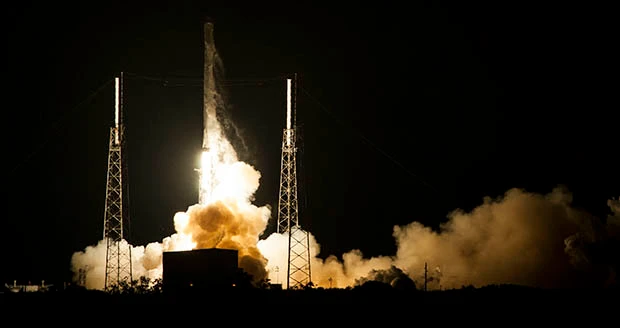
Cape Canaveral Air Force Station, Florida – In the early morning hours of Saturday, Jan. 10, 2015, Falcon 9 and Dragon began their fifth commercial resupply services mission to the International Space Station for NASA. Liftoff occurred at 4:47am EST from SpaceX’s Launch Complex 40 at Cape Canaveral Air Force Station, Florida. Just under 3 minutes after liftoff, Falcon 9’s nine Merlin first stage engines cut off and the first and second stages separated. Shortly thereafter, the second stage’s Merlin Vacuum engine ignited to begin a 7-minute burn that brings Falcon 9 and Dragon into low-Earth orbit. Dragon separated from the second stage about 10 minutes into flight, and Dragon’s solar arrays deployed about a minute later. Dragon was expected to reach the ISS in approximately two days with its 5,000 lb cargo.
Meanwhile, SpaceX attempted to land the first stage on an autonomous spaceport drone ship in the Atlantic Ocean after stage separation. While the rocket made it to the drone ship, it landed hard in the dark and fog. SpaceX founder Elon Musk tweeted, “Close, but no cigar this time.” He had given the controlled landing a 50-50 chance prior to the launch, which had been delayed from Tuesday by a technical fault.
Dragon will conduct a series of burns on its way to the space station, where it is targeted to be grappled around 6:00am EST on Monday, Jan. 12, 2015, and be berthed to station later that morning.
Source: SpaceX
Latest from Aerospace Manufacturing and Design
- Archer to test Starlink onboard its Midnight air taxis
- System eliminates cage-creep in sliding bearings
- Bodo Möller Chemie signs worldwide supply contract with Airbus
- Sandvik Coromant's CoroTurn Plus turning adapter
- ZOLLER Technology Days & Smart Manufacturing Summit May 13-14, 2026 in Ann Arbor, Michigan
- Walter's TC620 Supreme multi-row thread mill family
- ThermOmegaTech achieves CMMC Level 2 C3PAO certification
- One-touch precision flex locators