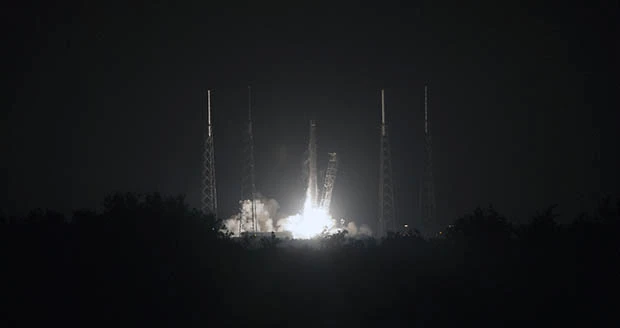
Kennedy Space Center, Florida – At 1:52:03 a.m. EDT on Sunday, Sept. 21, 2014, a SpaceX Dragon spacecraft sped skyward laden with 5,000 lb of scientific equipment and supplies destined for use by the crew of the International Space Station (ISS).
"This launch kicks off a very busy time for the space station," said NASA's Sam Scimemi, director of the ISS, noting upcoming launches of a Soyuz carrying the next crew of the station and launches of cargo spacecraft within a month.
Lifting off from Launch Complex-40 at Cape Canaveral Air Force Station, Fla., the SpaceX Falcon 9 rocket and Dragon flew on a path roughly paralleling the East Coast of America. The nine Merlin 1D engines of the first stage shut down as planned 2 minutes and 41 seconds into flight and the single Merlin engine of the second stage ignited to carry the Dragon the rest of the way into orbit.
Cheers greeted the video from Dragon as the second stage pushed itself away from the orbit-bound spacecraft and a pair of solar array "wings" unfolded to recharge the Dragon's batteries.
"There's nothing like a good launch, it's just fantastic," said Hans Koenigsman, vice president of Mission Assurance for SpaceX. "From what I can tell, everything went perfectly."
The launch began a two-day chase of the space station that is to end Tuesday morning when European Space Agency astronaut Alexander Gerst and NASA astronaut Reid Wiseman reach out to the uncrewed Dragon with the station's robot arm and maneuver the capsule to latch onto a port of the station. The station crew later will unload the equipment and supplies inside the Dragon.
The Dragon's payload includes the first 3D printer taken into space. The experiment is to demonstrate the potential to produce parts in orbit cheaply and on-demand instead of having to wait for them to be made on Earth and shipped into orbit on a cargo craft. The technology could be invaluable for future trips into deep space. The microgravity findings are also expected to refine 3D printing on Earth.
Also onboard to support 255 scientific investigations are 20 mice that will be used for microgravity research into bone density, and a device called ISS-RapidScat that will measure the winds on the Earth's ocean to improve weather forecasting and hurricane monitoring.
This mission was the fourth cargo flight to the station by a Dragon spacecraft, counting the first test flight in May 2012. The Dragon and Orbital Sciences' Cygnus spacecraft have become regular visitors to the space station as they deliver the supplies and equipment that allow research in a wide array of fields. The Dragon is to leave the station in mid-October for a plunge through Earth's atmosphere and a landing under parachutes in the Pacific Ocean where it will be recovered.
Source: NASA
Latest from Aerospace Manufacturing and Design
- Archer to test Starlink onboard its Midnight air taxis
- System eliminates cage-creep in sliding bearings
- Bodo Möller Chemie signs worldwide supply contract with Airbus
- Sandvik Coromant's CoroTurn Plus turning adapter
- ZOLLER Technology Days & Smart Manufacturing Summit May 13-14, 2026 in Ann Arbor, Michigan
- Walter's TC620 Supreme multi-row thread mill family
- ThermOmegaTech achieves CMMC Level 2 C3PAO certification
- One-touch precision flex locators