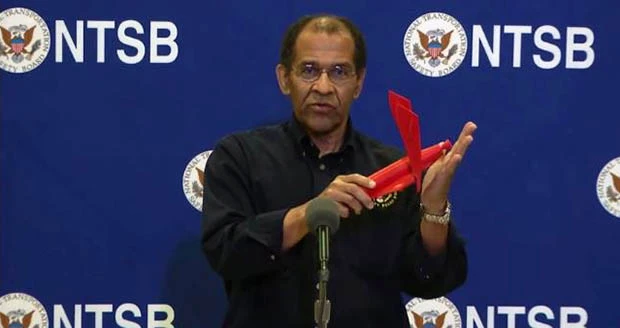
National Transportation Safety Board Acting Chairman Christopher A. Hart demonstrates with a model of SpaceShipTwo the tail in feather position.
Mojave, California – National Transportation Safety Board Acting Chairman Christopher A. Hart stated during a media briefing Nov. 2, 2014, that examination of the wreckage of Virgin Galactic’s SpaceShipTwo showed the fuel and oxidizer tanks and engine intact, with no sign of a breach or burn-through.
This finding contradicts initial speculation that the commercial rocket ship experienced an engine explosion a few seconds after it was released from its WhiteKnightTwo mother ship during a test flight above Mojave, California, on Oct. 31, 2014.
Still photos of the event taken from the ground show catastrophic disintegration of the space plane shortly after its engine was ignited at an altitude of 45,000ft. Peter Siebold, pilot of the Scaled Composites-built craft was seriously injured in parachuting from the stricken vehicle. Co-pilot Michael Alsbury was killed. They were the only crew aboard the 60ft-long, six-passenger spacecraft, which was destroyed undergoing its fourth supersonic, rocket-propelled test flight. The broken parts of the all-composite space craft were spread over a five-mile long track.
Speculation immediately after the accident focused on a change in formulation of the rocket’s solid fuel from a rubber-based compound to one made of plastic. It was thought initially that an engine or fuel tank explosion tore apart the space plane.
Hart told the media that video from inside the spacecraft moments before the accident showed the co-pilot had moved the tail feather control from locked to unlocked position. Unlocking is against procedure until a speed of Mach 1.4 is reached, but SpaceShipTwo was only at Mach 1.0 when the control handle was unlocked.
The tail booms are designed to hinge upward at the conclusion of a flight to slow the spaceship as it re-enters the atmosphere, a technique proven with the prototype SpaceShipOne. A second action would normally be required to put the tail in feathered position, and this did not occur. The tail booms apparently deployed to the feathered position on their own, two seconds after being unlocked, and nine seconds after the engine burn began. Aerodynamic forces may have caused the tail to move into the feathered position, leading to the space plane’s structural failure once proper flight attitude was compromised. Telemetry shows the engine burn was normal until then.
Hart stressed that his comments were statements of fact, and not of cause. He emphasized that the investigation was far from over. Portions of the space craft have been moved to a hangar, and the investigators will examine video, telemetry records, and eye-witness accounts. They will also consider the space craft’s design, the operators’ procedures, and safety culture.
NTSB Senior Investigator Lorenda Ward is leading the team as investigator-in-charge. Hart is accompanying the team and will serve as the principal spokesman during the on-scene phase of the investigation.
Finding answers could take months to a year, further delaying the first suborbital flight of paying passengers that Virgin Galactic had targeted for early 2015. A second SpaceShipTwo is approximately 60% complete, but its design may need modification before it flies.
A statement issued by Virgin Galactic management noted the team’s dedication to safety. “All of us at Virgin Galactic understand the importance of our mission and the significance of creating the first ever commercial spaceline. This is not a mission that anyone takes lightly.
“We believe that a thriving commercial space industry will have far reaching benefits for humanity, technology, and research for generations to come.
“Now is the time to focus on all those affected by this tragic accident and to work with the experts at the NTSB, to get to the bottom of what happened on that tragic day, and to learn from it so that we can move forward safely with this important mission.”
The cause of commercial spaceflight has been set back, but it is unclear for how long. SpaceShipTwo’s tragedy happened the same week that an un-crewed Orbital Sciences Antares rocket exploded on the launch pad at the start of a resupply mission to the International Space Station. The reason for that failure also remains undetermined.
Sources: NTSB, Virgin Galactic, Scaled Composites
Latest from Aerospace Manufacturing and Design
- The power of the plasma pen: Revolutionizing adhesion in aerospace manufacturing
- Mazak will show shops how to drive production at Dallas Open House
- Heavy-duty pneumatic flex locators
- Tacky Tape vacuum bag sealing tapes for aerospace composites continue a legacy
- Embraer’s Phenom 300 series is best-selling light jet for 14th consecutive year
- Expanded PushPull connector portfolio
- AEC is Meltio’s official sales partner
- Coolant-thru options for straight, 90-degree, universal live tools