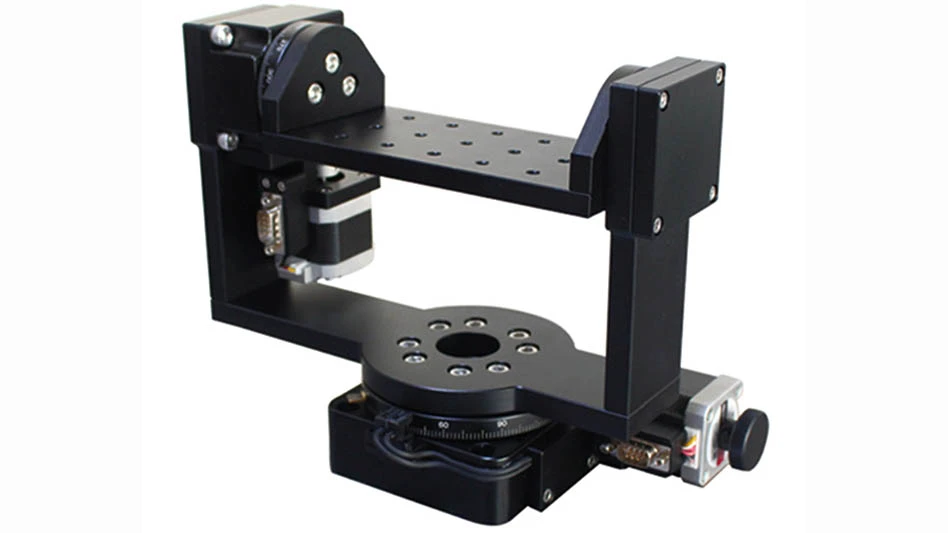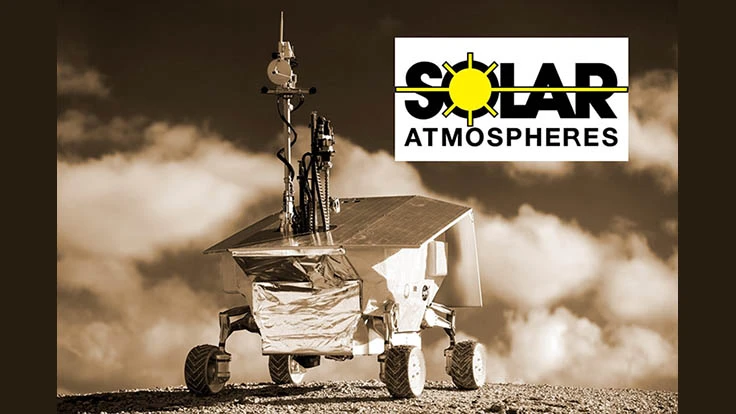
Honeybee planetary drill (NASA photo)
Souderton, Pennsylvania – Honeybee Robotics, with three locations in the USA, has received NASA funding to help develop future planetary exploration, space mining and in-situ resource utilization. One of the projects is the High Temperature Venus Drill and Sample Delivery System to provide drilling and sampling operations in the challenging environmental conditions of the planet Venus.
Honeybee Robotics selected Solar Atmospheres to provide heat treating for the robotic explorer on drive train components comprised of a specialized alloy, Ferrium C61. The alloy is designed as a high strength, high fracture toughness carburizing grade steel capable of high temperature applications in corrosive environments.
Solar Atmospheres developed the processing to optimize the properties of the specialty alloy and satisfy the demanding heat-treat requirements. The drive train components are vacuum carburized at 1,825°F, high-pressure nitrogen gas quenched, frozen at -150°F, and tempered in a vacuum at 900°F. Given the severe conditions used to process the alloy, one can understand why it was selected for the Venus drilling application.
Venus is the hottest planet in our solar system at a constant 895°F with an atmospheric pressure 90x higher than the air pressure on Earth.
Source: Solar Atmospheres
Latest from Aerospace Manufacturing and Design
- Archer to test Starlink onboard its Midnight air taxis
- System eliminates cage-creep in sliding bearings
- Bodo Möller Chemie signs worldwide supply contract with Airbus
- Sandvik Coromant's CoroTurn Plus turning adapter
- ZOLLER Technology Days & Smart Manufacturing Summit May 13-14, 2026 in Ann Arbor, Michigan
- Walter's TC620 Supreme multi-row thread mill family
- ThermOmegaTech achieves CMMC Level 2 C3PAO certification
- One-touch precision flex locators