Stratford, Conn. – Sikorsky Aircraft Corp., a subsidiary of United Technologies Corp., has successfully completed an initial series of tests required by the Naval Air Systems Command to verify the structural strength of the CH-53K heavy lift helicopter.
 Conducted on a full-size, non-flying airframe called the static test article, the tests are part of a three-year program to validate the largest helicopter ever designed and built by Sikorsky. The tests are designed to show if the CH-53K has the structural integrity to operate safely over its entire flight envelope — from its empty gross weight of 44,000 lb up to its maximum gross weight of 88,000 lb with external load.
"The static test article will enable Sikorsky to replicate the many stresses, strains and aerodynamic forces the CH-53K helicopter will experience during all aspects of flight, whether the aircraft is empty, filled with cargo, or carrying up to 36,000 pounds of gear suspended beneath the aircraft by an external sling," says Mike Torok Sikorsky's CH-53K Program vice president. "By placing incrementally heavier static loads on various parts of the airframe assembly — including those well beyond the airframe's analytical design strength — we can measure structural integrity, airworthiness and crash worthiness, and verify safety margins for all expected operational conditions."
The tests are part of Sikorsky’s $3.8 billion system development and demonstration contract with the U.S. Navy for the new helicopters.
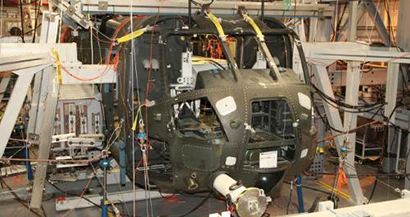
Housed in a specially-built test facility at Sikorsky's manufacturing plant in Stratford, Conn., the test machine consists of the cockpit, cabin, fuel sponsons, a transition section, and the tail rotor pylon. The complete airframe assembly is suspended off the ground by the shaft of its main rotor gearbox. Surrounding support beams hold the numerous hydraulic cylinders that apply the flight and inertial loads to parts of the airframe assembly.
Also attached are component-representative weights that simulate the presence of the engines and landing gear. Sikorsky has completed six test conditions on the static test article, all conducted during 2013 and early 2014.
Sikorsky will continue to test the structural integrity of the CH-53K static test article for another two years to validate the effects of aerodynamic forces and weight distribution on different sections of the airframe.
Source: United Technologies Corp.
Latest from Aerospace Manufacturing and Design
- Archer to test Starlink onboard its Midnight air taxis
- System eliminates cage-creep in sliding bearings
- Bodo Möller Chemie signs worldwide supply contract with Airbus
- Sandvik Coromant's CoroTurn Plus turning adapter
- ZOLLER Technology Days & Smart Manufacturing Summit May 13-14, 2026 in Ann Arbor, Michigan
- Walter's TC620 Supreme multi-row thread mill family
- ThermOmegaTech achieves CMMC Level 2 C3PAO certification
- One-touch precision flex locators