Lockheed Martin Corp.
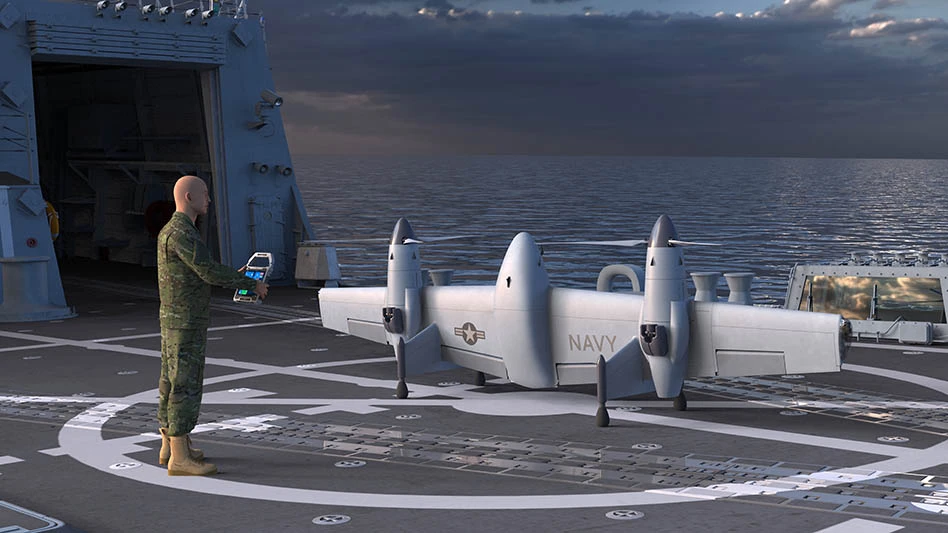
Sikorsky, a Lockheed Martin company, is conducting flight tests to mature the control laws and aerodynamics of a novel vertical takeoff and landing uncrewed aerial system (VTOL/UAS). The flight tests are intended to prove the efficiency and scalability of a twin proprotor “rotor blown wing” configuration that sits on its tail to take-off and land like a helicopter, and transitions easily to horizontal forward flight for long-endurance missions, such as intelligence, surveillance, reconnaissance (ISR), and targeting.
Rotor blown wing refers to the constant airflow from the proprotor wash across the wing. Sikorsky chose the design to reduce drag on the wing in hover mode and when transitioning to forward flight, and to increase cruise efficiencies and endurance.
The design is just one of the many ways Sikorsky is advancing 21st Century Security technologies and innovations, said Igor Cherepinsky, director of rapid prototyping group Sikorsky Innovations.
The ongoing flight tests support the ANCILLARY initiative by the Defense Advanced Research Projects Agency (DARPA), which seeks to develop a Class 3 UAS VTOL X-Plane that can operate in most weather conditions from ship decks and unprepared surfaces without infrastructure. Sikorsky is one of several competitors selected to advance their UAS conceptual designs into the next development phase.
“Flight tests are underway to verify our tail-sitting rotor blown wing UAS can launch and land vertically with high stability, and cruise efficiently on wing,” said Cherepinsky. “Key enablers to flight maneuverability, and future vehicle scalability, are our MATRIX autonomy flight control system, and an articulated rotor system similar to those in traditional helicopters.”
For the flight tests now underway, Sikorsky is flying a proof-of-concept vehicle powered by a battery. If selected to produce an air vehicle for a future ANCILLARY phase, Sikorsky plans to build a 300 lb hybrid-electric version to include a 60 lb ISR payload.
Sikorsky Innovations was formed in 2010 to overcome technological challenges to rotary wing speed, autonomy, and intelligence. Learn more about the engineering team’s achievements in speed and intelligence, and its current focus on electrification and VTOL UAS to support 21st Century Security missions.
Latest from Aerospace Manufacturing and Design
- The power of the plasma pen: Revolutionizing adhesion in aerospace manufacturing
- Mazak will show shops how to drive production at Dallas Open House
- Heavy-duty pneumatic flex locators
- Tacky Tape vacuum bag sealing tapes for aerospace composites continue a legacy
- Embraer’s Phenom 300 series is best-selling light jet for 14th consecutive year
- Expanded PushPull connector portfolio
- AEC is Meltio’s official sales partner
- Coolant-thru options for straight, 90-degree, universal live tools