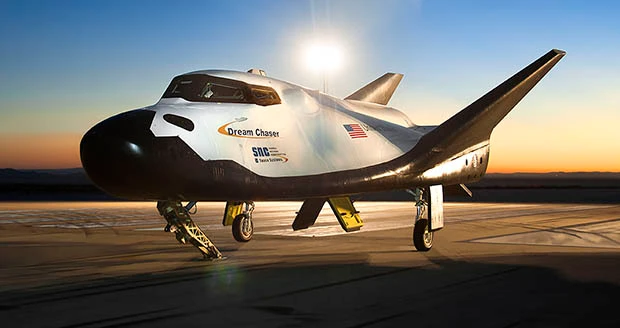
Sparks, Nevada – Sierra Nevada Corp. (SNC) has filed a legal challenge to the award of contracts to Boeing and SpaceX under the Commercial Crew Transportation Capability (CCtCap) program (U.S. Government Accountability Office (GAO) Docket no. B-410485). The CCtCap program will restore U.S. transportation capability to the International Space Station.
SNC, Boeing, and SpaceX submitted separate proposals for the CCtCap program. While all three competitors were found to be compliant and awardable under the criteria set forth in the request for proposal (RFP), only two proposals were selected (Boeing and SpaceX), one of which would result in a substantial increased cost to the public despite near equivalent technical and past performance scores, according to SNC.
In its 51 year history, SNC has never filed a legal challenge to a government contract award. However, in the case of the CCtCap award, NASA’s own Source Selection Statement and debrief indicate that there are serious questions and inconsistencies in the source selection process according to the documents filed with the GAO. SNC officials say that there is no alternative but to institute a legal challenge.
A company press release states that, in this time of critical budget limits, it is more important than ever to deliver the best value to the American public. With the current awards, the U.S. government would spend up to $900 million more at the publicly announced contracted level for a space program equivalent to the program that SNC proposed. Given those facts, SNC asserts that a thorough review must be conducted of the award decision. The company’s management believes it owes this extra effort to its employees, the more than 30 Dream Team U.S. industry partners, 10 university partners, 10 international space agency and industry partners – all of whom believe in Dream Chaser and that the proposal that was submitted by SNC is the best choice for NASA and the American public.
Importantly, the official NASA solicitation for the CCtCap contract prioritized price as the primary evaluation criteria for the proposals, setting it equal to the combined value of the other two primary evaluation criteria: mission suitability and past performance. SNC’s Dream Chaser proposal was the second lowest priced proposal in the CCtCap competition. SNC’s proposal also achieved mission suitability scores comparable to the other two proposals. Out of a possible 1,000 total points, the highest ranked and lowest ranked offers were separated by a minor amount of total points and other factors were equally comparable.
SNC officials say the Dream Chaser design provides a wider range of capabilities and value, including preserving the heritage of the space shuttle program through its design as a piloted, reusable, lifting-body spacecraft that embodies the advanced technologies of today and flexibility that enables the innovations of the future. It was also the only vehicle remaining in the Commercial Crew Program that was not a capsule.
SNC’s filing seeks a further detailed review and evaluation of the submitted proposals and capabilities. SNC officials believe the result of further evaluation of the proposals submitted will be that America ends up with a more capable vehicle, at a much lower cost, with a robust and sustainable future.
Sierra Nevada Corp.’s Space Systems business area based in Louisville, Colorado, designs and manufactures advanced spacecraft, space vehicles, rocket motors and spacecraft subsystems and components for the U.S. Government, commercial customers, as well as for the international market. SNC’s Space Systems has more than 25 years of space heritage and has participated in more than 400 successful space missions through the delivery of over 4,000 systems, subsystems and components. During its history, SNC’s Space Systems has concluded over 70 programs for NASA and over 50 other clients.
Source: Sierra Nevada Corp.
Latest from Aerospace Manufacturing and Design
- Archer to test Starlink onboard its Midnight air taxis
- System eliminates cage-creep in sliding bearings
- Bodo Möller Chemie signs worldwide supply contract with Airbus
- Sandvik Coromant's CoroTurn Plus turning adapter
- ZOLLER Technology Days & Smart Manufacturing Summit May 13-14, 2026 in Ann Arbor, Michigan
- Walter's TC620 Supreme multi-row thread mill family
- ThermOmegaTech achieves CMMC Level 2 C3PAO certification
- One-touch precision flex locators