UK airline easyJet, along with its partners Airbus and Nicarnica Aviation, has successfully completed the final stage of testing for the AVOID volcanic ash technology through a unique experiment involving the creation of an artificial ash cloud.
An A400M Airbus test plane dispersed one tonne of Icelandic ash into the atmosphere at between 9,000ft and 11,000ft thereby creating conditions consistent with the 2010 eruption of Iceland's Eyjafjallajökull volcano. A second Airbus test aircraft, an A340-300, with the AVOID technology fitted, flew towards the ash cloud identifying and measuring it from around 60km away. The experiment also used a small aircraft, a Diamond DA42 from Duesseldorf University of Applied Sciences, to fly into the ash cloud to take measurements which help to corroborate the measurements made by the AVOID system.

The ash cloud produced during the test was between 600ft and 800ft deep measuring 2.8km in diameter. To begin with, the ash cloud was visible to the naked eye but dissipated quickly becoming difficult to identify.
The AVOID volcanic sensor detected the ash cloud and measured its density which ranged from 0.1g to 1g/m2 – or concentrations of 100 to 1000 μg/m3. This is within the range of concentrations measured during the Eyjafjallajokul ash crisis in April and May 2010.
Ian Davies, easyJet's Engineering Director, says, "The threat from Icelandic volcanoes continues and so we are delighted with the outcome of this unique and innovative experiment. Finding a solution is as crucial now as ever to ensure we never again see the scenes of spring 2010 when all flying ceased across Europe for several days.
"This is a key step in the final journey of testing the technology and moving towards commercial certification. easyJet will now work towards a non-integrated stand-alone system which we aim to fit onto a number of our current fleet of aircraft by the end of 2014."
Dr Fred Prata, inventor of the AVOID technology, notes, "The team has just executed a unique scientific and engineering experiment conclusively demonstrating that low concentrations of ash can be identified by the AVOID sensor. The highly successful outcome of this complex experiment which involved delivering 1000kg of fine ash into a small airspace, controlling four aircraft and coordinating the measurements from two of the aircraft, is a testament to the commitment and skills of easyJet and AIRBUS engineers and a great example of industry and science coming together to solve an important problem."
Charles Champion, Airbus’ Executive Vice President, Head of Engineering, says, "Airbus, since it was first formed more than 40 years ago, has supported and performed many test programs both independently and also in collaboration with other organizations. Today with AVOID we wanted to prove in the project that the ash-detection concept can work and this has been demonstrated in the test. Now we need to analyze all data gathered.” He adds, "We are at the beginning of an invention which could become a useful solution for commercial aviation to prevent large-scale disruption from volcanic ash."
The risk of another Icelandic eruption remains high as Magnús Tumi Gudmundsson from the Institute of Earth Sciences in Iceland, explains: "Explosive volcanic eruptions in Iceland happen on average once every 5 years. When winds blow from the northwest, the ash is transported towards Europe as it did during the Eyjafjallajökull eruption in 2010. It is not possible to predict when or where the next eruption will take place. What is certain is that it will happen."
For a week in April 2010, 80% fewer flights operated in European airspace, with more than 100,000 flights cancelled in total.
The ash, with the consistency of fine talc, which was used in the test came from the 2010 eruption. Creating an ash cloud provided the team with an advantage because they knew exactly how much ash was in the atmosphere.
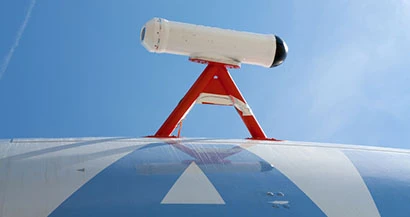
The AVOID system can be likened to a weather radar for ash. Created by Dr Fred Prata of Norway-based Nicarnica Aviation, the system utilizes infrared technology fitted to aircraft to supply images to pilots and an airline’s operations control center. The images will enable pilots to see an ash cloud, up to 100km ahead of the aircraft and at altitudes between 5,000ft and 50,000ft, thus allowing them to make small adjustments to the plane’s flight path to avoid any ash cloud.
On the ground, information from aircraft with AVOID technology would be used to build an accurate image of the volcanic ash cloud using real time data. This could open up large areas of airspace that would otherwise be closed during a volcanic eruption.
Source: Airbus
Latest from Aerospace Manufacturing and Design
- Archer to test Starlink onboard its Midnight air taxis
- System eliminates cage-creep in sliding bearings
- Bodo Möller Chemie signs worldwide supply contract with Airbus
- Sandvik Coromant's CoroTurn Plus turning adapter
- ZOLLER Technology Days & Smart Manufacturing Summit May 13-14, 2026 in Ann Arbor, Michigan
- Walter's TC620 Supreme multi-row thread mill family
- ThermOmegaTech achieves CMMC Level 2 C3PAO certification
- One-touch precision flex locators