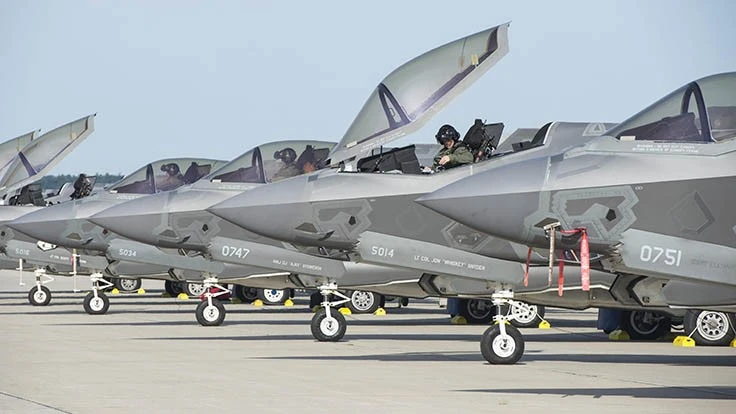
33rd Fighter Wing F-35As on an exercise in Wisconsin in 2016. (US Air Force photo)
On Aug. 13, 2018, President Donald J. Trump signed into law the National Defense Authorization Act (NDAA) for Fiscal Year 2019. The bill’s $716 billion includes funding of about $639 billion for the Pentagon’s base budget and defense programs of the Energy Department. It also allows for another $69 billion for the Overseas Contingency Operations (OCO) war fund account, according to The Hill.
Trump signed the bill during a visit to Fort Drum, New York, where he was joined by Vice President Pence, Deputy Defense Secretary Patrick Shanahan, and the Joint Chiefs of Staff.
“We will replace aging tanks, aging planes, and ships with the most advanced and lethal technology ever developed, and hopefully we’ll be so strong we’ll never have to use them,” Trump said.
Among the specific hardware mentioned, the NDAA authorizes $7.6 billion to procure 77 F-35 fighter jets. However, final bill blocks delivery of F-35s to Turkey until the Pentagon completes an assessment of deteriorating U.S.-Turkish relations.
The bill also provides $24.1 billion to fund the construction of 13 new battle-force ships.
The bill grows military personnel by authorizing an increase of 15,600 troops across the Army, Navy, Air Force, and Marine Corps, and raises military pay 2.6% – the largest increase in nine years. It also authorizes the United States Space Command to be established under the United States Strategic Command.
The act additionally authorizes $500 million to co-develop and co-produce missile defense systems for Israel and $250 million dedicated to security assistance for Ukraine.
Named for Senate Armed Services Committee Chairman John S. McCain (R-Arizona), Congress sent the NDAA (H.R.5515) to the president on Aug. 3, the earliest in the year Congress has completed an NDAA in more two decades, according to the White House’s national security and defense fact sheet.
Congress must now pass a defense spending bill to realize the funding the NDAA authorizes. The House passed a Pentagon spending bill in June, while the Senate may start considering its version as soon as this week.
Latest from Aerospace Manufacturing and Design
- Archer to test Starlink onboard its Midnight air taxis
- System eliminates cage-creep in sliding bearings
- Bodo Möller Chemie signs worldwide supply contract with Airbus
- Sandvik Coromant's CoroTurn Plus turning adapter
- ZOLLER Technology Days & Smart Manufacturing Summit May 13-14, 2026 in Ann Arbor, Michigan
- Walter's TC620 Supreme multi-row thread mill family
- ThermOmegaTech achieves CMMC Level 2 C3PAO certification
- One-touch precision flex locators