When you are on your sofa in your living room and want to entertain yourself, it has now become seamless to interchange your personal tablet, your phone, and your television in a mix-and-match of technology and content. Apps on your personal electronic device (PED) can stream entertainment stored directly on the device, on your home network or from an Internet or cable provider. Viewer apps on your PED can also send the image to your big screen TV. All of that is done very simply and at a flick of a finger.
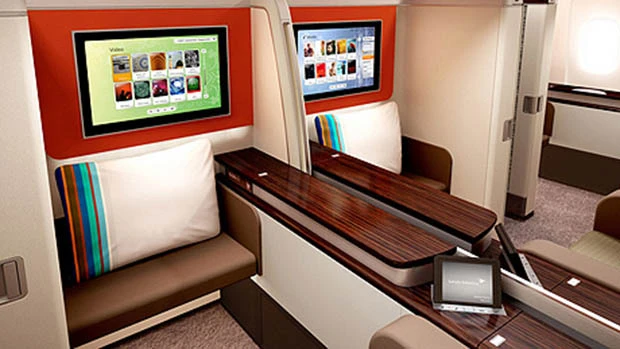
A recent survey by DePaul University has found that 36% of airline passengers are using smart phones on the airplane while another 12% are using tablets. Yet, the flexibility to enjoy personalized entertainment existing on the ground has not yet translated to the sky. At first glance, it seems like all the necessary components are there: the smart seat-back entertainment system is linked to a large library of local content; on-board high bandwidth internet connectivity is quite common; the use of PEDs is encouraged and supported by an in-seat power supply. Despite the fact that many of these systems run similar technology (e.g. Android operating systems), some engineering challenges remain in providing seamless integration of the kind found on the ground. This is about to change.
Airlines and inflight entertainment (IFE )system providers are now consulting engineering services companies to solve the three main challenges standing in the way of the bring your own device (BYOD) evolution: connectivity, bandwidth and security.
System complexity
Connectivity between a PED and the airplane IFE systems come in multiple layers of complexity. First of all, the passenger assumes that such connection will be wireless. This is also due to the fact that wired connections are too device-dependent. Of all the connection options, the one between a PED and a seat-back screen, or point-to-point connection, is the least complex. It could use technology similar to that of AppleTV/ChromeCast, or use standard technologies like BLE, MHL, DLNA and NFC. This would allow the passenger to take advantage of the higher resolution, physical size or capability (e.g. 3D viewing) of the seat-back screen to view content stored on the PED. The next level of complexity is the connection between a PED and the content stored on the onboard IFE server. For airplanes with small or no seat-back screens, it still offers IFE content to the passenger on their own PED or one provided by the airline. Although more complex, this connection challenge can be overcome by the use of an airline-specific app to reduce the discrepancies between devices. In all cases, connectivity is to be as simple as using a light switch, because you cannot expect the flight attendants to become tech support specialists in addition to all their other duties. Finally, the most difficult connection for the IFE system would be the ability to stream ground-based content such as Netflix over the airplane’s Internet satellite connection. Streaming such content on the seat-back screen will raise issues of privacy since the passengers would have to use their own account. But even if they use their own PED, the system will have to overcome the second engineering challenge: bandwidth.
System performance
It is easy to understand that if 41% of passengers on a 500-seat A380 stream video content over the satellite link, the connectivity will suffer from bandwidth issues. Airlines are addressing this problem today with various levels of success. One airborne Internet service has recently come under fire for blocking bandwidth-heavy applications and websites. On one recent Lufthansa flight, a flight attendant simply pleaded over the PA system for passengers to share the bandwidth. Obviously, bandwidth management needs to be addressed, just like it is on the ground in a corporate environment. In addition, even if point-to-point and PED-to-server connections do not hit the satellite link, they need to have enough bandwidth to provide good service quality to each seat on the aircraft. Therefore, issues of content compression, as well as router management and onboard positioning need to be addressed.
And what about security? Corporate BYOD specialists always talk about the security challenges of using such PED in a controlled environment.
System security
Despite rumors spread by some, there is no danger to the flight operation when using PEDs for IFE. This scenario presents so much technical implausibility, practical implausibility, and operational implausibility that it is not worth entertaining. IFE and connectivity systems are conceived to be completely separated from the critical flight systems which must be absolutely isolated by design. This requirement is well understood and enforced through a rigorous certification process.
Next is the issue of a malware uploaded from a PED and infecting the IFE system itself. Although not technically impossible, it can easily be addressed by using some network firewall or monitoring technology, as well as an airline specific application, likely to be deployed for connectivity anyway. It is more of a challenge in cases where passengers exchange content (like IMs, pictures and videos). Even multi-player network gaming could pose a threat. Should such incident still occur, file encryption can be used to protect the data.
But the real security challenge is content piracy of the server-based entertainment. Since many BYOD security breaches in corporate business are related to employees disclosing data outside the enterprise through an information leak, present Hollywood content licensing strictly disallows the streaming of early-window movies to passengers’ own devices for fear that they can be pirated. Rather than having a controlled set of seat-back devices and a controlled IFE environment that they can manage, the system must deal with a variety of devices that end users have purchased. Airlines have no control over that choice and what's already loaded on those PEDs. Therefore, personalized and flexible inflight entertainment solutions will have to address this challenge through the use of proprietary applications and anti-screen-capture device software technology.
Conclusion
Only when these complexity, performance, and security challenges are addressed through system engineering will passengers have the same entertainment flexibility at 36,000ft as they have in their living rooms.
Our team has addressed these challenges for top, global IFE system companies whose products are deployed across major global carriers. We have accelerated system-level testing using device automation frameworks with limited efforts. This includes testing the complex systems for performance (and latency) and security in mock-setups for hundreds of passenger entertainment units connected to the content servers. We also have the experience of building custom secure applications for mobile devices, tuned to enable BYOD. Our clients have won laurels at the APEX Expo for the innovative solutions for which we have contributed.
Latest from Aerospace Manufacturing and Design
- The power of the plasma pen: Revolutionizing adhesion in aerospace manufacturing
- Mazak will show shops how to drive production at Dallas Open House
- Heavy-duty pneumatic flex locators
- Tacky Tape vacuum bag sealing tapes for aerospace composites continue a legacy
- Embraer’s Phenom 300 series is best-selling light jet for 14th consecutive year
- Expanded PushPull connector portfolio
- AEC is Meltio’s official sales partner
- Coolant-thru options for straight, 90-degree, universal live tools