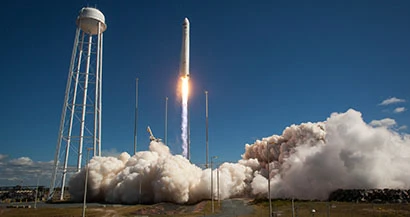
Orbital Sciences Corp. has successfully launched its Antares rocket carrying the company’s Cygnus cargo logistics spacecraft into its intended orbit. The launch marked the beginning of a four-day in-orbit capabilities demonstration mission that will culminate in rendezvous and berthing with the International Space Station (ISS) on Sept. 22, 2013. Cygnus will deliver approximately 1,500 lb of cargo and remain attached to the ISS for 30 days before departing with up to 1,750 lb of disposal cargo.
Lift-off of Orbital’s Antares rocket occurred at approximately 10:58 a.m. EDT on Sept. 18, 2013, from the Mid-Atlantic Regional Spaceport (MARS) located at NASA’s Wallops Flight Facility in eastern Virginia. Following a 10-minute ascent, the Cygnus spacecraft was successfully deployed by the Antares upper stage and placed into its intended orbit between 160mi and 180mi above the Earth. Approximately 20 minutes later, Orbital’s Cygnus engineers confirmed that reliable communications had been established and that the solar arrays were fully deployed, providing the necessary electrical power to command the spacecraft.
“The Cygnus spacecraft appears to be fully healthy and operating as expected during this early phase of its mission,” says David W. Thompson, Orbital’s president and CEO. “Over the next few days, our Cygnus team, together with our NASA partners, will conduct an extensive series of in-orbit tests to verify the performance of the spacecraft before attempting the rendezvous and berthing operations with the space station.”
Cygnus consists of a common Service Module (SM) and a Pressurized Cargo Module (PCM). The SM incorporates avionics, power and propulsion systems already successfully flown aboard other Orbital satellite products. The PCM, designed and built by Thales Alenia Space under a subcontract from Orbital, is based on the Multi-Purpose Logistics Module (MPLM) used with the Space Shuttle.
This demonstration flight is the final milestone in Orbital’s Commercial Orbital Transportation Services (COTS) joint research and development initiative with NASA. Under COTS, NASA and Orbital developed Cygnus, which meets the stringent human-rated safety requirements for ISS operations. Orbital privately developed the Antares launch vehicle to provide access to space for medium-class payloads. Together, these elements are being used for the demonstration flight of Orbital’s commercial resupply capability to the ISS.
Pending the successful completion of the COTS program, Orbital will begin regularly scheduled cargo delivery missions to the ISS under the $1.9 billion Commercial Resupply Services (CRS) contract with NASA. Under the CRS contract, Orbital will deliver approximately 20,000kg of cargo to the ISS over eight missions through 2016. For these missions, NASA will manifest a variety of essential items based on ISS program needs, including food, clothing, crew supplies, spare parts and equipment, and scientific experiments.
Latest from Aerospace Manufacturing and Design
- Archer to test Starlink onboard its Midnight air taxis
- System eliminates cage-creep in sliding bearings
- Bodo Möller Chemie signs worldwide supply contract with Airbus
- Sandvik Coromant's CoroTurn Plus turning adapter
- ZOLLER Technology Days & Smart Manufacturing Summit May 13-14, 2026 in Ann Arbor, Michigan
- Walter's TC620 Supreme multi-row thread mill family
- ThermOmegaTech achieves CMMC Level 2 C3PAO certification
- One-touch precision flex locators