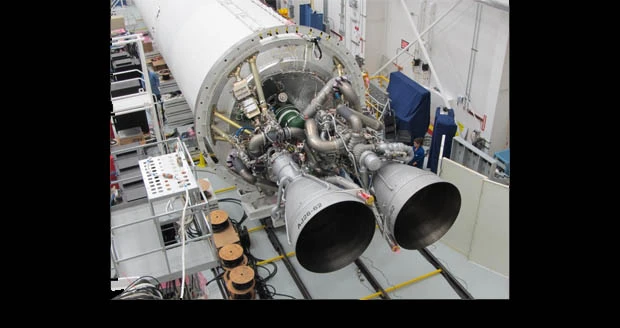
Antares' AJ26 stage one main engines
Dulles, Virginia – Orbital Sciences Corp. officials have announced comprehensive plans to fulfill company contract commitments under NASA’s Commercial Resupply Services (CRS) program and to accelerate an upgrade of the Antares medium-class launcher’s main propulsion system. Under the new approach and in line with Orbital’s existing CRS contract, all remaining cargo will be delivered to the International Space Station (ISS) by the end of 2016. There will be no cost increase to NASA and only minor adjustments will be needed to the cargo manifest in the near term.
Orbital’s Antares launch failure Accident Investigation Board (AIB) is making good progress in determining the primary cause of the Oct. 28, 2014 failure. A preliminary review of telemetry and video data has been conducted and substantial debris from the Antares rocket and its Cygnus payload has been collected and examined. While the work of the AIB continues, preliminary evidence and analysis conducted to date points to a probable turbopump-related failure in one of the two Aerojet Rocketdyne AJ26 stage one main engines. As a result, the use of these engines for the Antares vehicle likely will be discontinued.
The AJ26 engine was chosen originally because it was the highest thrust-to-weight kerosene engine available. The simple design and technological approach eliminates exotic materials, coatings, and complex manufacturing processes, according to company literature. Aerojet designed, developed, and implemented modifications to transform the engines originally produced for the Soviet moon program into configurations suitable for application to U.S. launch vehicles.
Company officials did not identify the intended successor to the AJ26 in a recent press conference, but to maintain the CRS program’s ISS supply line, Orbital plans an early introduction of its previously selected Antares propulsion system upgrade in 2016. This will be preceded by one or two non-Antares launches of the company’s Cygnus cargo spacecraft to the ISS in 2015-2016, employing the spacecraft’s compatibility with various launch vehicles and its flexibility to accommodate heavier cargo loads as launcher capacity permits. In addition, the company expects repairs to the Mid-Atlantic Regional Spaceport (MARS) launch complex at NASA’s Wallops Flight Facility to be undertaken quickly, allowing launch operations to continue at Wallops Island with the upgraded Antares beginning in 2016.
“Orbital is taking decisive action to fulfill our commitments to NASA in support of safe and productive operations of the Space Station. While last week’s Antares failure was very disappointing to all of us, the company is already implementing a contingency plan to overcome this setback. We intend to move forward safely but also expeditiously to put our CRS cargo program back on track and to accelerate the introduction of our upgraded Antares rocket,” said David W. Thompson, Orbital’s chairman and chief executive officer.
Orbital will continue to use the Cygnus cargo spacecraft because it can be launched on third-party launch vehicles and accommodate heavier cargo loads as allowed by more capable launchers. Taking advantage of the spacecraft's flexibility, Orbital will purchase one or two non-Antares launch vehicles for Cygnus flights in 2015 and possibly in early 2016 and combine them with several upgraded Antares rocket launches of additional Cygnus spacecraft in 2016 to deliver all remaining CRS cargo.
The potential alternative launch providers were not named, but Orbital management said the company is in discussions now with two based in the U.S. and one based in Europe. Indications are favorable that these launch operators have available capacity for Cygnus launches in 2015 and 2016. By consolidating the cargo of five previously-planned CRS missions into four more capable ones, the company plans to maintain a similar or better delivery schedule than the one before the launch failure, completing all current CRS program cargo deliveries by the end of 2016.
With both third-party launch vehicles and with the upgraded propulsion system on Antares, the Cygnus capacity will expand, on average, from 2,600kg to about 3,300kg. The basic enhanced Cygnus that was already planned to come online next year is the same one Orbital plans to use now. It will just be able to carry slightly heavier cargo loads because the launch vehicles will be more capable in terms of their payload capacity, Thompson said.
.
“We very much appreciate the tremendous support Orbital has received from NASA and Virginia’s MARS commercial spaceport team over the last seven years on our Antares rocket and CRS cargo programs. We look forward to working closely with them to quickly recover from last week’s setback,” Thompson concluded.
Source: Orbital Sciences Corp.
Latest from Aerospace Manufacturing and Design
- Archer to test Starlink onboard its Midnight air taxis
- System eliminates cage-creep in sliding bearings
- Bodo Möller Chemie signs worldwide supply contract with Airbus
- Sandvik Coromant's CoroTurn Plus turning adapter
- ZOLLER Technology Days & Smart Manufacturing Summit May 13-14, 2026 in Ann Arbor, Michigan
- Walter's TC620 Supreme multi-row thread mill family
- ThermOmegaTech achieves CMMC Level 2 C3PAO certification
- One-touch precision flex locators