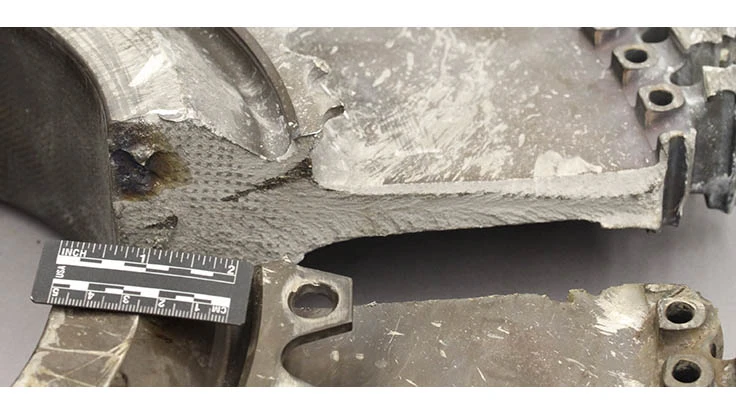
Fatigue crack location on a disk fracture surface
Washington, D.C. – As part of its ongoing investigation of an Oct. 28, 2016, uncontained engine failure on American Airlines flight 383, the National Transportation Safety Board (NTSB) has issued an investigative update.
The uncontained failure of a GE CF6-80C2B6 engine occurred on a Boeing 767-300 (N345AN) during the take-off roll at Chicago O'Hare International Airport. An emergency evacuation of the 161 passengers and nine crew members onboard was conducted.
Initial findings include the following:
According to witness statements from airport personnel, video evidence, flight data recorder (FDR) data, and GPS data, the airplane experienced an uncontained failure of the right engine about 6,550ft from runway 28R threshold, and came to a full stop about 9,225ft from runway 28R threshold.
Preliminary FDR data show that the right engine failure occurred at an airspeed of about 128kts with the engine operating at takeoff power.
As a result of the uncontained engine failure, a fuel leak resulted in a pool fire under the right wing.
Airport rescue and firefighting personnel began applying foam within 2 minutes 51 seconds of being notified of the emergency.
The right engine stage 2 high pressure turbine disk fractured into at least 4 pieces. One piece went through the inboard section of the right wing, over the fuselage and into a UPS warehouse facility adjacent to the airport.
Most of the stage 2 disk was recovered and sent to the NTSB laboratory in Washington, D.C. for examination. One of the fractures exhibited features consistent with fatigue cracking initiating at an internal inclusion near the forward side of the hub’s inner bore.
The disk had 10,984 cycles and had a life limit of 15,000 cycles. Review of the engine maintenance and manufacturing records and processes are ongoing.
Ongoing metallurgical examinations of the disk will focus on detailed characterization of the inclusion and the fracture surfaces.
Parties to the investigation include the Federal Aviation Administration, American Airlines, Allied Pilots Association, The Boeing Company, General Electric Engines, the Transport Workers Union of America and the Association of Professional Flight Attendants.
Source: The National Transportation Safety Board
Latest from Aerospace Manufacturing and Design
- The power of the plasma pen: Revolutionizing adhesion in aerospace manufacturing
- Mazak will show shops how to drive production at Dallas Open House
- Heavy-duty pneumatic flex locators
- Tacky Tape vacuum bag sealing tapes for aerospace composites continue a legacy
- Embraer’s Phenom 300 series is best-selling light jet for 14th consecutive year
- Expanded PushPull connector portfolio
- AEC is Meltio’s official sales partner
- Coolant-thru options for straight, 90-degree, universal live tools