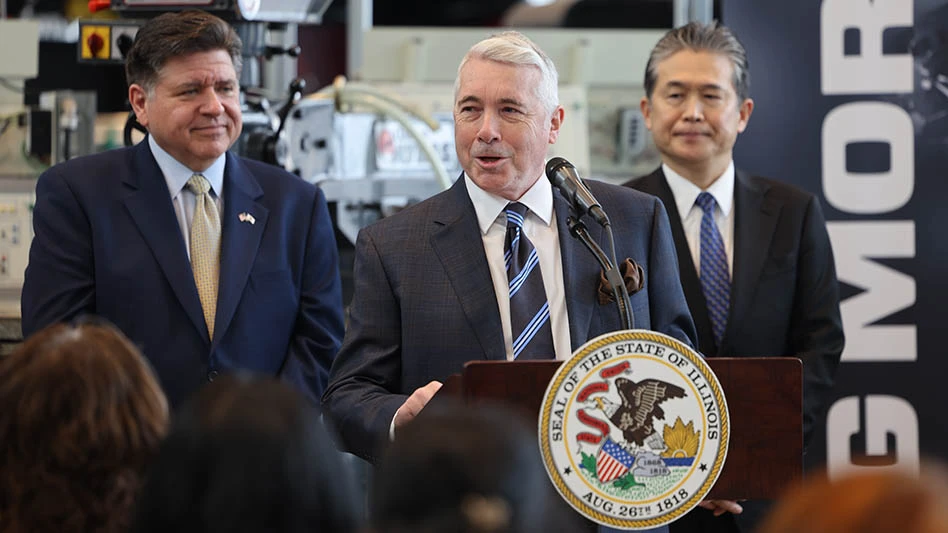
Defense Secretary Ash Carter, center, Air Force Secretary Deborah Lee James, and Air Force Chief of Staff Gen. Mark A. Welsh III announce the long range strike bomber contract award at the Pentagon. (U.S. Air Force)
Falls Church, Virginia – Defense Department officials announced Oct. 27, 2015, the contract award of engineering and manufacturing development (EMD) and early production for the Long Range Strike Bomber (LRS-B), to Northrop Grumman Corp. This selection continues the company's 35-year partnership with the Air Force in providing advanced long-range strike systems.
Defense Secretary Ash Carter said during a Pentagon briefing announcing the contract, "Building this bomber is a strategic investment in the next 50 years, and represents our aggressive commitment to a strong and balanced force. It demonstrates our commitment to our allies and our determination to potential adversaries, making it crystal clear that the United States will continue to retain the ability to project power throughout the globe long into the future."
Secretary of the Air Force Deborah Lee James noted, “The LRS-B will allow the Air Force to operate in tomorrow's high end threat environment, what we call anti-access aerial denial environment. It will also give us the flexibility and the capability to launch from the continental United States air strikes that would be able to strike any location in the world.”
The LRS-B is designed to replace the Air Force’s aging fleets of bombers – ranging in age from 50+ years for the B-52 to 17+ years for the B-2 – with a long range, highly survivable bomber.
The LRS-B is designed to have an open architecture allowing integration of new technology and timely response to future threats across the full range of military operations. Gen. Mark A. Welsh III, chief of staff of the Air Force, said, “This open architecture will help ensure competition throughout the life cycle of the program, and make it easier to modify the platform as technology advances and the threats evolve.
The program incentivizes industry to achieve cost, schedule, and performance goals. The LRS-B contract is composed of two parts. The contract for the EMD phase is estimated at $21.4 billion in 2010 dollars. The second part of the contract is composed of options for the first 5 production lots, comprising 21 aircraft of a fleet of 100. Based on approved requirements, the average procurement unit cost (APUC) per aircraft is required to be equal to or less than $550 million per aircraft in 2010 dollars across the fleet. The APUC announced is $511 million per aircraft in 2010 dollars, or $564 each in 2016 dollars. Approximately $1.9 billion was appropriated during the past four fiscal years for risk-reduction activities to reach the EMD phase now. Along with $23.5 billion in engineering and development costs, the total cost to purchase the entire fleet is estimated at $80 billion.
“If we remain disciplined and keep program requirements stable, we should beat this estimate,” said Dr. William A. LaPlante, assistant secretary of the Air Force for acquisition.
No details relative to specific components or subcontractors were released, due to classification and enhanced security requirements. The as-yet unnamed bomber is projected to reach initial operational capability in 2025.
The Northrop Grumman proposal beat the one offered by a competing team comprised of Boeing and Lockheed Martin.
"The Air Force has made the right decision for our nation's security," said Wes Bush, chairman, chief executive officer and president, Northrop Grumman. "As the company that developed and delivered the B-2 Spirit stealth bomber, we look forward to providing the Air Force with a highly-capable and affordable next-generation Long-Range Strike Bomber.
"Our team has the resources in place to execute this important program, and we're ready to get to work," Bush added.
Sources: Air Force News Service, Northrop Grumman
Latest from Aerospace Manufacturing and Design
- Precision XY gantry system
- Archer to test Starlink onboard its Midnight air taxis
- System eliminates cage-creep in sliding bearings
- Bodo Möller Chemie signs worldwide supply contract with Airbus
- Sandvik Coromant's CoroTurn Plus turning adapter
- ZOLLER Technology Days & Smart Manufacturing Summit May 13-14, 2026 in Ann Arbor, Michigan
- Walter's TC620 Supreme multi-row thread mill family
- ThermOmegaTech achieves CMMC Level 2 C3PAO certification