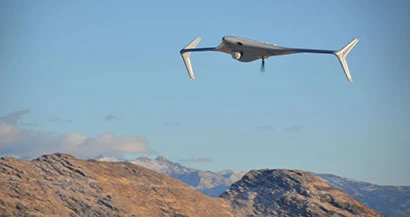
Northrop Grumman Corp. has integrated and employed an internal miniature electronic attack payload on the Bat unmanned aircraft, marking the first time that such a system was used in operation on a Group III (small, tactical) unmanned aircraft system.
The demonstration involved the jamming of radars during the Marine Aviation Weapons and Tactics Squadron One (MAWTS-1) Weapons and Tactics Instructor (WTI) event at Naval Air Weapons Station China Lake, Calif., in October.
"Bat continues to demonstrate capabilities that can normally only be achieved by larger, more expensive unmanned aircraft," said George Vardoulakis, Northrop Grumman's vice president of Medium Range Tactical Systems. "Our customers now have a more mobile and affordable option for electronic warfare missions."
The Pandora electronic attack payload is a low-cost derivative of Northrop Grumman's family of upgraded digital APR-39 systems. The lightweight, multifunction payload provides electronic attack, support, and protection. Pandora was integrated on Bat in less than 2 months.
During the WTI event, the Bat completed multiple flights in collaboration with fixed wing and other unmanned platforms.
Bat is a tactical, runway independent unmanned aircraft that can be launched from land or sea. Its flexible design allows for quick installation of a variety of payloads and enables rapid, expeditionary deployment.
Source: Northrop Grumman Corp.
Latest from Aerospace Manufacturing and Design
- Archer to test Starlink onboard its Midnight air taxis
- System eliminates cage-creep in sliding bearings
- Bodo Möller Chemie signs worldwide supply contract with Airbus
- Sandvik Coromant's CoroTurn Plus turning adapter
- ZOLLER Technology Days & Smart Manufacturing Summit May 13-14, 2026 in Ann Arbor, Michigan
- Walter's TC620 Supreme multi-row thread mill family
- ThermOmegaTech achieves CMMC Level 2 C3PAO certification
- One-touch precision flex locators