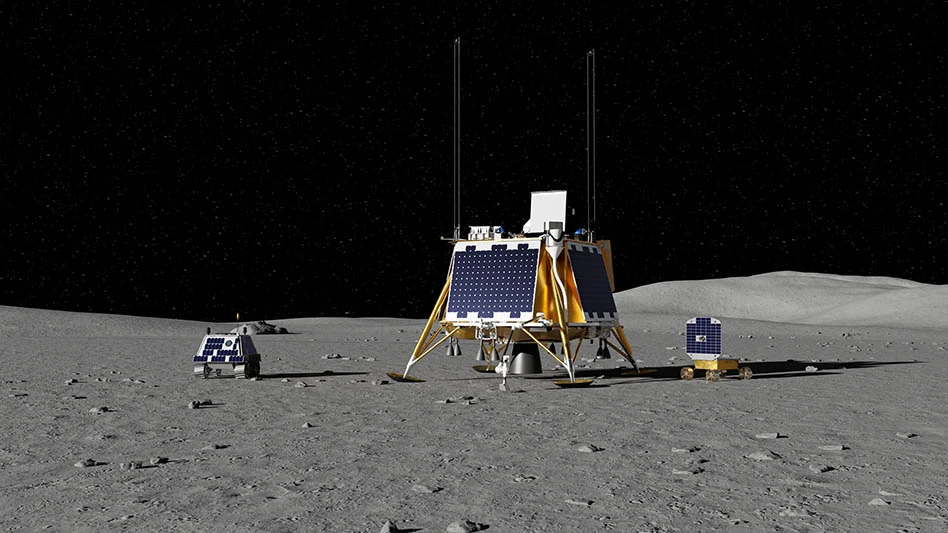
Photo Credit: Firefly Aerospace
NASA has awarded Firefly Aerospace of Cedar Park, Texas, $176.7 million to deliver two rovers and three scientific instruments to the lunar surface as part of the agency’s Commercial Lunar Payload Services (CLPS) initiative and Artemis campaign to explore more of the moon than ever before.
This delivery is the first time NASA will use multiple rovers and a variety of stationary instruments, in a collaborative effort with the Canadian Space Agency (CSA) and the University of Bern, to help understand the chemical composition of the lunar south pole region and discover the potential for using resources available in permanently shadowed regions of the moon.
Under the new CLPS task order, Firefly is tasked with delivering end-to-end payload services to the lunar surface, with a period of performance to March 29, 2030. The company’s lunar lander is targeted to land at the moon’s south pole region in 2029.
“Firefly is honored to support another NASA CLPS task order as a proven, reliable partner for robotic missions to the moon,” said Jason Kim, CEO of Firefly Aerospace. “Following our first Blue Ghost mission that made history just a few months ago, this bold Firefly team proved we have the right mix of grit, innovation, and dedication to not only stick the landing, but also complete all scientific objectives for our payload partners. We’ve set the bar high, and we aim to continue setting new records in our missions to come with our active production line of Blue Ghost landers.”
This is Firefly’s fifth task order award and fourth lunar mission through CLPS. Firefly’s first delivery landed on the moon’s near side in March 2025 with 10 NASA payloads. The company’s second mission, targeting a launch in 2026, includes a lunar orbit drop-off of a satellite combined with a delivery to the lunar surface on the far side. Firefly’s third lunar mission will target landing in the Gruithuisen Domes on the near side of the moon in 2028, delivering six experiments to study enigmatic lunar volcanic terrain.
The rovers and instruments part of this newly awarded flight include:
- MoonRanger, an autonomous microrover that will explore the lunar surface collecting images and telemetry data while demonstrating autonomous capabilities for lunar polar exploration. Its onboard Neutron Spectrometer System instrument will study hydrogen-bearing volatiles and the composition of lunar regolith, or soil.
Lead development organizations: NASA’s Ames Research Center in California’s Silicon Valley, and Carnegie Mellon University and Astrobotic, both in Pittsburgh. - Stereo Cameras for Lunar Plume Surface Studies will use enhanced stereo imaging photogrammetry, active illumination, and ejecta impact detection sensors to capture the impact of the rocket exhaust plume on lunar regolith as the lander descends on the moon’s surface. The high-resolution stereo images will help predict lunar regolith erosion and ejecta characteristics, as bigger, heavier spacecraft and hardware are delivered to the moon near each other in the future.
Lead development organization: NASA’s Langley Research Center in Hampton, Virginia. - Laser Retroreflector Array is an array of eight retroreflectors on an aluminum support structure that enables precision laser ranging, a measurement of the distance between the orbiting or landing spacecraft to the reflector on the lander. The array is a passive optical instrument functioning without power and will serve as a permanent location marker on the moon for decades to come.
Lead development organization: NASA’s Goddard Space Flight Center in Greenbelt, Maryland. - A CSA Rover is designed to access and explore remote south pole areas of interest, including permanently shadowed regions, and to survive at least one lunar night. The CSA rover has stereo cameras, a neutron spectrometer, two imagers (visible to near-infrared), a radiation micro-dosimeter, and a NASA-contributed thermal imaging radiometer developed by the Applied Physics Laboratory. These instruments will advance our understanding of the physical and chemical properties of the lunar surface, the geological history of the moon, and potential resources such as water ice. It will also improve our understanding of the environmental challenges that await future astronauts and their life support systems.
Lead development organization: CSA. - Laser Ionization Mass Spectrometer mass spectrometer will analyze the element and isotope composition of lunar regolith. The instrument will utilize a Firefly-built robotic arm and Titanium shovel that will deploy to the lunar surface and support regolith excavation. The system will then funnel the sample into its collection unit and use a pulsed laser beam to identify differences in chemistry compared to samples studied in the past, like those collected during the Apollo program. Grain-by-grain analyses will provide a better understanding of the chemical complexity of the landing site and the surrounding area, offering insights into the evolution of the moon.
Lead development organization: University of Bern in Switzerland.
Through the CLPS initiative, NASA purchases lunar landing and surface operations services from American companies. The agency uses CLPS to send scientific instruments and technology demonstrations to advance capabilities for science, exploration, or commercial development of the moon, and to support human exploration to Mars.
Latest from Aerospace Manufacturing and Design
- Enhanced visitor experience highlighted at TMTS 2026
- This week: Tube bending and workholding solutions to implement now
- Dassault Aviation unveils the Falcon 10X
- Industrial round bumpers
- Defense Industry Trends webinar with Greenwich Capital Group
- Air Astana finalizes order for 25 Airbus A320neo family aircraft
- Syensqo showcases high-performance sustainable composites at JEC World 2026
- Multi-axis laser processing system