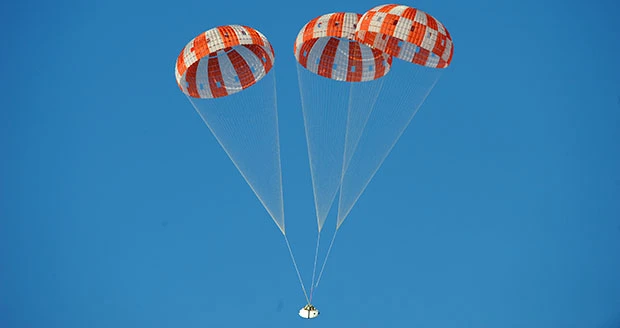
Washington – The team designing the parachute system for NASA’s Orion spacecraft has demonstrated almost every parachute failure they could imagine. But on April 23, 2014, they tested how the system would perform if the failure wasn’t in the parachutes.
Orion is the safest spacecraft ever built to carry humans, and its Launch Abort System can take a good deal of the credit for that distinction. In an emergency on the launch pad or during the early stages of ascent, it can activate in milliseconds to pull the crew to safety. Once it has pulled the crew away from the emergency, it’s up to the parachutes to bring them down for a safe landing.
“We hope we never have to use the parachutes this way,” said Chris Johnson, project manager for the parachutes. “We want to see them deploy after a successful mission every time. But we need to know they can perform in an emergency, too.”
In a pad abort or a low altitude launch abort, Orion’s three main parachutes would be called on to lower the crew module to the ground without the help of the two drogues that normally precede them. The parachute system won’t have as long to do the job since the spacecraft will be at much lower altitude than for a nominal reentry mission, and with the vehicle going slower, they won’t deploy as quickly. And on top of all of these factors, the crew module will be flying sideways when the parachutes deploy, instead of falling straight down as it does during reentry.
To simulate those conditions, a test version of Orion was dropped from a C-17 at 13,000ft above the U.S. Army’s Yuma Proving Ground, with the main parachutes deploying soon after leaving the plane, before the capsule had a chance to straighten out. All the elements worked together and the parachutes reached a fully open state setting up a soft landing as expected. But the real value of the test will come with the data the engineers were able to gather from it.
“We wanted to record how long it took to inflate the parachutes in a launch pad abort scenario and collect data on how the different conditions affected the quality of the parachute deployment,” Johnson said. “With this test successfully completed, our next step is to dig into that information and use it to fine tune the launch abort trajectories for flight.”
In addition to the new test conditions, this was also the first time that the steel risers connecting the parachute lines to Orion were replaced with the textile risers that will be incorporated into future Orion spacecraft after Orion’s first flight this year. The new risers are lighter and more flexible – two qualities that will come in particularly handy when Orion is ready to carry humans into space.
While engineers continue to test Orion's parachutes for future missions, engineers at NASA's Kennedy Space Center in Florida continue to make progress on the Orion spacecraft being prepared for its December trip to space. Inside the Operations and Checkout Building high bay, the crew module is positioned on a special portable test chamber for multi-point random vibration testing. Accelerometers and strain gauges have been attached to Orion in various locations. During a series of tests, each lasting only 30 seconds, Orion is being subjected to gradually increasing levels of vibrations that simulate levels the vehicle will experience during launch, orbit, and descent. The data will be reviewed to assess the health of the crew module.
The spacecraft ran for 26 uninterrupted hours during the final phase of a major test series completed April 8 at the agency's Kennedy Space Center in Florida. The test verified the crew module can route power and send commands that enable the spacecraft to manage its computer system, software and data loads, propulsion valves, temperature sensors, and other instrumentation.
"This has been the most significant integrated testing of the Orion spacecraft yet," said William Gerstenmaier, associate administrator for NASA's human exploration and operations at the agency's headquarters in Washington. "The work done to test the avionics with the crew module isn't just preparing us for Orion's first trip to space in a few months. It's also getting us ready to send crews far into the solar system."
In October 2013, NASA and Lockheed Martin engineers powered on Orion's main computer for the first time. Since then, they have installed harnessing, wiring, and electronics. This was the first time engineers ran the crew module through its paces to verify all system actuators respond correctly to commands and all sensors report back as planned. More than 20 miles of wire are required to connect the different systems being powered.
"Getting all the wiring right, integrating every element of the avionics together, and then testing it continuously for this many hours is a big step toward getting to deep space destinations," said Mark Geyer, Orion program manager.
In May, the heat shield will be installed and, shortly thereafter, the crew module will be attached with the service module.
Orion’s first flight will launch an uncrewed capsule 3,600 miles into space for a four-hour mission to test several of its most critical systems, including its parachutes. After making two orbits, Orion will return to Earth at almost 20,000mph and endure temperatures near 4,000°F before its parachutes slow it down for a landing in the Pacific Ocean.
EFT-1 is targeted for launch in December.
Source: NASA
Latest from Aerospace Manufacturing and Design
- Making workholding work for you
- CAE to deliver full flight simulator to Embraer-CAE Training Services
- Website helps users quickly search, evaluate, specify machine tool accessories
- HondaJet Elite II Emergency Autoland is FAA certified
- Software for creating measurement programs updated
- Nidec Aerospace establishes Atlanta hub to accelerate electric propulsion innovation
- Brochure for high-precision motion control, nanopositioning automation, piezo solutions
- Forecast 2026 Webinar