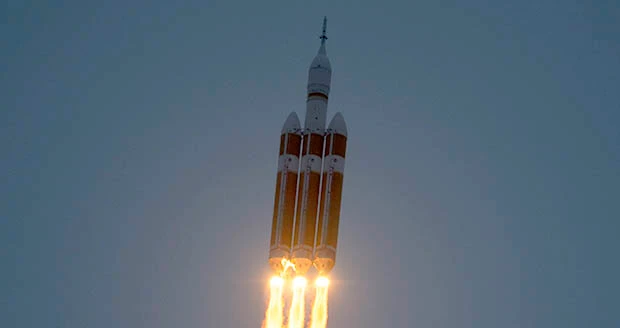
The United Launch Alliance Delta IV Heavy rocket, with NASA's Orion spacecraft mounted atop, lifts off from Cape Canaveral Air Force Station's Space Launch Complex 37 at 7:05 a.m. EST, Friday, Dec. 5, 2014. (NASA/Bill Ingalls)
NASA's Kennedy Space Center, Florida – NASA marked a critical step on the journey to Mars with its Orion spacecraft during a roaring liftoff into the dawn sky over eastern Florida on Friday, Dec. 5, 2014, aboard a Delta IV Heavy rocket.
Once on its way, the Orion spacecraft accomplished a series of milestones as it jettisoned a set of fairing panels around the service module before the launch abort system tower pulled itself away from the spacecraft as planned.
The spacecraft and second stage of the Delta IV rocket settled into an initial orbit about 17 minutes after liftoff. Flight controllers put Orion into a slow roll to keep its temperature controlled while the spacecraft flew through a 97-minute coast phase.
The cone-shaped spacecraft did not carry anyone inside its cabin but is designed to take astronauts farther into space than ever before in the future.
A Dec. 4, 2014, launch attempt was scrubbed due to valve issues that could not be remedied before the launch window closed. Several valves are used to fill and drain the first stage of the Delta IV rocket with propellant prior to liftoff.
During a 4 1/2-hour, two-orbit mission, the Orion spacecraft reached a peak altitude of 3,604 miles above Earth, about 15 times higher than the International Space Station – farther into space than any ship for humans has gone since the Apollo missions. This was a key point in the test flight, as instruments inside Orion recorded the radiation doses inside the cabin – critical data for mission planners considering the best way to safely send astronauts into deep space in the future.
The Orion crew module then returned to Earth's atmosphere at speeds of 20,000mph (32,000km/h) – testing a heat shield strong enough to protect against 4,000°F temperatures – before executing reentry maneuvers that allowed it to splash down in the Pacific Ocean approximately 600 miles southwest of San Diego at 11:29 a.m. EST.
Live video of the Orion reentry – from the deployment of the capsule’s drogue parachutes to descent under three, large canopies – was provided by NASA Armstrong’s Ikhana remotely piloted aircraft.
A team from NASA, the U.S. Navy, and Orion prime contractor Lockheed Martin performed recovery operations, including towing the crew module into the well deck of the USS Anchorage ahead of its return to U.S. Naval Base, San Diego and then on to NASA’s Kennedy Space Center in Florida.
“There were a few moments when I held my breath, but today’s flight couldn’t have gone better,” said Mike Hawes, Lockheed Martin vice president and Orion program manager. “Orion is going to push the boundaries of scientific discovery, and for the men and women of Lockheed Martin who have worked tirelessly for the last six years to make this test possible, it’s an honor to be a part of this moment in history.”
“Today was a great day for America,” said Flight Director Mike Sarafin from his console at Mission Control at Johnson Space Center in Houston. “While this mission was unmanned, we were all aboard Orion.”
With lessons learned from Orion’s flight test, NASA can improve the spacecraft's design while building the first Space Launch System rocket, a heavy booster with enough power to send the next Orion to a distant retrograde orbit around the moon for Exploration Mission-1. Following that, astronauts are gearing up to fly Orion on the second SLS rocket on a mission that will return astronauts to deep space for the first time in more than 40 years. These adventures will set NASA up for future human missions to an asteroid and even on the journey to Mars.
Sources: NASA, Lockheed Martin
Latest from Aerospace Manufacturing and Design
- Precision XY gantry system
- Archer to test Starlink onboard its Midnight air taxis
- System eliminates cage-creep in sliding bearings
- Bodo Möller Chemie signs worldwide supply contract with Airbus
- Sandvik Coromant's CoroTurn Plus turning adapter
- ZOLLER Technology Days & Smart Manufacturing Summit May 13-14, 2026 in Ann Arbor, Michigan
- Walter's TC620 Supreme multi-row thread mill family
- ThermOmegaTech achieves CMMC Level 2 C3PAO certification