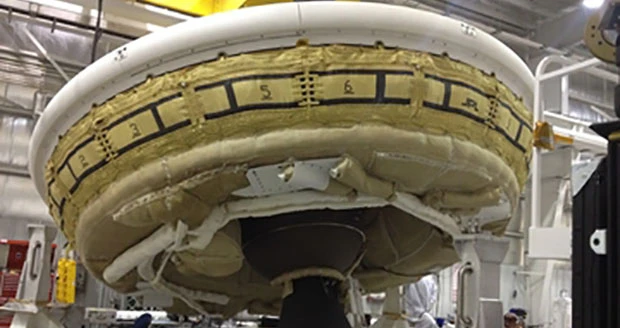
Washington – NASA's flying saucer-shaped test vehicle is ready to take to the skies from the U.S. Navy's Pacific Missile Range Facility in Kauai, Hawaii, for its first engineering shakeout flight. ?
The first launch opportunity for the test vehicle is June 3, when the launch window opens at 8:30 a.m. HST. The test will be carried live on NASA TV and streamed on the Web. The low density supersonic decelerator (LDSD) will gather data about landing heavy payloads on Mars and other planetary surfaces. ?
"The agency is moving forward and getting ready for Mars as part of NASA's Evolvable Mars campaign," says Michael Gazarik, associate administrator for Space Technology at NASA Headquarters in Washington. "We fly, we learn, we fly again. We have two more vehicles in the works for next year." ?
As NASA plans increasingly ambitious robotic missions to Mars, laying the groundwork for even more complex human science expeditions to come, accommodating extended stays for explorers on the Martian surface will require larger and heavier spacecraft. ?
The objective of the LDSD project is to see if the cutting-edge, rocket-powered test vehicle operates as it was designed – in near-space at high Mach numbers. ?
"After years of imagination, engineering and hard work, we soon will get to see our Keiki o ka honua, our 'boy from Earth,' show us its stuff," says Mark Adler, project manager for the LDSD at NASA's Jet Propulsion Laboratory (JPL) in Pasadena, California. "The success of this experimental test flight will be measured by the success of the test vehicle to launch and fly its flight profile as advertised. If our flying saucer hits its speed and altitude targets, it will be a great day." ?
NASA will use a helium balloon, when inflated roughly the size of a football stadium, to lift the vehicle to 120,000 ft., Adler says. "From there we drop it for about one and a half seconds. After that, it's all about going higher and faster – and then it's about putting on the brakes." ?
A fraction of a second after dropping from the balloon, and a few feet below it, four small rocket motors will fire to spin up and gyroscopically stabilize the saucer. A half second later, a Star 48B long-nozzle, solid-fueled rocket engine will kick in with 17,500 lb of thrust, sending the test vehicle to the edge of the stratosphere. ?
Source: NASA?
Latest from Aerospace Manufacturing and Design
- The power of the plasma pen: Revolutionizing adhesion in aerospace manufacturing
- Mazak will show shops how to drive production at Dallas Open House
- Heavy-duty pneumatic flex locators
- Tacky Tape vacuum bag sealing tapes for aerospace composites continue a legacy
- Embraer’s Phenom 300 series is best-selling light jet for 14th consecutive year
- Expanded PushPull connector portfolio
- AEC is Meltio’s official sales partner
- Coolant-thru options for straight, 90-degree, universal live tools