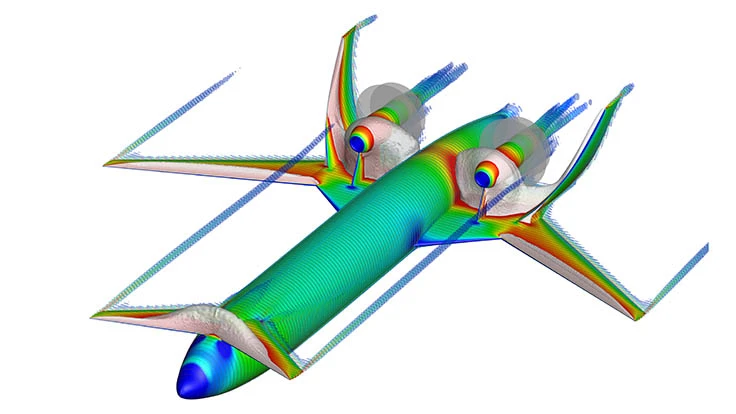
Hamburg, Germany – The German Aerospace Center (Deutsches Zentrum für Luft- und Raumfahrt; DLR) and NASA are tasking students within Germany and the United States to develop aircraft designs that reinvent passenger flight beyond the sound barrier or that are revolutionarily quiet and low-emission. German participants from seven universities kicked off the competition at a meeting at the Center of Applied Aeronautical Research (ZAL) in Hamburg on Feb. 17, 2017. Competition proposals must be submitted by June 30, 2017. The winners from Germany will visit the U.S. in the autumn, where they will present their work to NASA alongside the U.S. competition.
"With the DLR/NASA Design Challenge, we want to give the next generation of aviation researchers the opportunity and the impetus to actively achieve a breakthrough to the aircraft of the future," explains DLR Executive Board member responsible for aeronautics Rolf Henke. "Our greatest challenge as researchers is to improve the environmental performance of air traffic despite the increasing number of passengers worldwide, thereby reducing emissions and noise. This will require the fresh ideas of young minds, and we are very pleased to have the opportunity to launch this initiative together with NASA."
"NASA and DLR have enjoyed a long history of cooperation," says Jaiwon Shin, NASA associate administrator for aeronautics. "It is our hope by bringing together the aerospace leaders of the future to work on common design challenges, we can build an even stronger transatlantic partnership going forward."
The competition calls for design proposals for quieter flying and efficient supersonic jets. The participating student teams in Germany and the United States can choose one of these topics for their competition entry.
Category 1: Revolutionary quiet and low-emission flying
Climate change and society's ever-increasing demand for mobility present major challenges for today's aviation industry. Ambitious goals in Europe and the United States are considering the technical limits for less emissions, less noise, and greater efficiency in passenger air transport. To reconcile long-term continuous growth and environmental compatibility, the technical limits must be exceeded. The competition calls for revolutionary new ideas – from aircraft to propulsion technology concepts.
Category 2: Supersonic challenge
Concorde is history and, for the time being, so is commercial passenger flight at supersonic speeds. The competition poses the question of whether, by means of new technologies, it is possible to revitalize supersonic transport across long distances without disproportionate environmental pollution. Aerospace researchers around the world are already working on this: The focus lies on increasing energy efficiency and reducing the supersonic boom to pave the way for the renaissance of supersonic flight.
Sixty-three students from Germany have registered for the NASA/DLR Design Challenge. There will also be a double-digit number of participating teams from various universities in the United States. One winning team will be selected from each side, announced by the end of July.
Source: German Aerospace Center (DLR)
Latest from Aerospace Manufacturing and Design
- The power of the plasma pen: Revolutionizing adhesion in aerospace manufacturing
- Mazak will show shops how to drive production at Dallas Open House
- Heavy-duty pneumatic flex locators
- Tacky Tape vacuum bag sealing tapes for aerospace composites continue a legacy
- Embraer’s Phenom 300 series is best-selling light jet for 14th consecutive year
- Expanded PushPull connector portfolio
- AEC is Meltio’s official sales partner
- Coolant-thru options for straight, 90-degree, universal live tools