By Dhaval Shah, Product Manager, eInfochips
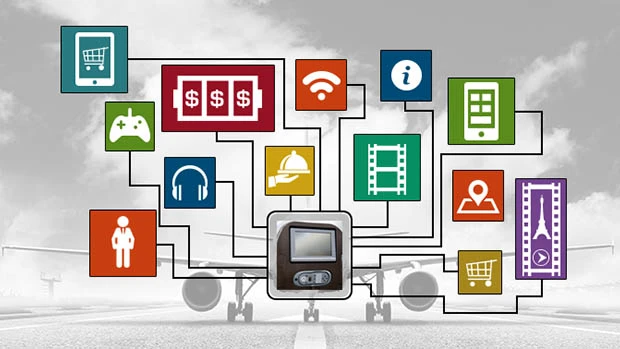
As you take your pre-assigned seat, the inflight entertainment system welcomes you by name, in your native language. It shows you the weather and news headlines for your final destination on this journey. After selecting the entertainment menu, the system immediately offers you the option to watch the last part of the movie you could not finish on the previous flight. You are also presented with a selection of your favorite Spotify music, the ante for a real game of poker against other passengers, as well as the newest releases from your Netflix queue.
Is this a flight of fantasy?
Not really.
With innovative engineering solutions that leverage developments in connectivity technologies, Internet-of-Things (IoT) and Big Data analytics – we are poised to change the way airlines and business jet operators manage content and deliver inflight infotainment.
 As modern aircraft join the fleet for longer hauls on point-to-point routes, passenger experience becomes the important competitive differentiating factor. In multiple recent surveys, incentives such as inflight entertainment (IFE) system capability, onboard connectivity, or “bring-your-own-device” (BYOD) options have gained prominence in the passengers’ choice of a carrier. As a consequence, avionics providers are feverishly looking in to bring innovative concepts to the skies.
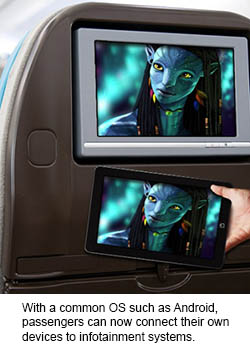
Connectivity over broadband networks has opened up new business channels for the airline, and entertainment options for passengers – such as the ability to stream music or check Facebook from a Smartphone. As aircraft infotainment systems adopt popular frameworks like Android, personal devices brought on board by passengers will connect to passenger seat displays. Infotainment manufacturers have already initiated this transition, with Android-based IFE touchscreen panels and touchscreen user consoles. IFE systems can support air-to-ground communications for Wi-Fi availability on aircraft.
While in the air, airlines have the uninterrupted attention of millions of high-income people for hours on end, which makes this the best time and place to deliver e-commerce solutions. The airlines can capture the user’s profile and past purchases from loyalty programs or their Amazon, BestBuy, or IMDB logins, and suggest items that they are more likely to buy, or movies that they are more likely to watch. The day when the age-old duty-free cart is replaced by an interactive catalog that draws inspiration from the e-commerce experience is not far away. Passengers can read and write reviews, see different pictures and product videos, and compare prices with the airport shop at the destination. Passengers pay through a secure connection, with a credit card or PayPal, or even in exchange of frequent-flyer miles. The best part is their purchases will be ready for them as they land. Also, with integrated e-commerce and m-commerce, passengers can access the product catalog through the IFE system, a mobile phone, laptop, or tablet.
 While the luxury cruises reap huge profits by offering gambling over international waters, airlines could now consider offering such services over international air space. Many casino games have gone digital, so why not bring those games to certified and secure onboard servers? We have enhanced the gaming experience with custom graphics acceleration and frame-fusion for a pseudo-3D effect, and also improved the user experience and reliability for casino products. Airlines can introduce digital casino gaming between passengers as well, and keep them engaged and entertained, especially on long-haul flights.
 Today, aircraft operators pay a flat fee for the music and movies they provide on board. Every month, someone has to decide what movies to offer, in what language, along with what popular music to load in the virtual juke box. No matter what passengers actually watch or listen to, the fee is the same. But with intelligent devices, flight entertainment systems could track actual usage. These systems could then be able to answer questions like what films are the most popular, on which route, and in what language? Music and videos could be uploaded specifically based on predicted usage, and fees could be paid based on actual consumption. So if a passenger watches the first 10 minutes of a movie, the airline only pays a part of the content fees to the production house. This pay-as-you-use model can potentially disrupt the current content monetization model, and encourage the best content to be available on board. This would result in savings for the aircraft operator while definitely increasing customer satisfaction.
But rather than stopping at optimizing entertainment by aircraft or by route, why not take personalization to the next level by taking advantage of big data available on the ground? With new NoSQL database technology like MongoDB, it is now possible to assemble vast amount of data from a variety of devices and applications for just-in-time processing. Through its own systems, aircraft operators already have the passenger’s itinerary and personal information such as nationality and language. If, in exchange for a better experience, customers would also volunteer additional preferences from their Facebook page, Netflix queue, or Spotify playlists, a completely personalized flight experience could be created for every passenger at every seat of every flight. Beyond movies they want to see or music they prefer, passengers could also access destination related information, travel video, or news broadcasts. They could see movies that were filmed there or become familiar with local music or food. This service could be delivered on an aircraft seat or on a custom app for the passenger’s device. The more information shared and collected, the more personalized the service would become and the more options could be offered.
So with a combination of data processing, aircraft connectivity, graphics processing, and usage tracking, new entertainment systems will be revolutionary. Before aircraft push back, they would offer just-in-time passenger data preference processing and airborne entertainment server upload. After landing, actual entertainment usage download and passenger profile integration would take place. These new systems take the flying experience to a whole new level.
As connectivity, the Internet-of-Things, and Big Data start changing the world around us on the ground, there is no reason why such innovation could not take flight and improve our experience in the air. We look forward to building the next generation of IFE systems that would change the flying experience based on these technologies.
Latest from Aerospace Manufacturing and Design
- Archer to test Starlink onboard its Midnight air taxis
- System eliminates cage-creep in sliding bearings
- Bodo Möller Chemie signs worldwide supply contract with Airbus
- Sandvik Coromant's CoroTurn Plus turning adapter
- ZOLLER Technology Days & Smart Manufacturing Summit May 13-14, 2026 in Ann Arbor, Michigan
- Walter's TC620 Supreme multi-row thread mill family
- ThermOmegaTech achieves CMMC Level 2 C3PAO certification
- One-touch precision flex locators