Cape Canaveral Air Force Station, Florida – The third Mobile User Objective System (MUOS) satellite built by Lockheed Martin for the U.S. Navy is now responding to commands after being launched. An initialization team, led by the company, is operating the MUOS-3 satellite from the Naval Satellite Operations Center located at the Naval Base Ventura County, Point Mugu, California.
The MUOS satellite constellation operates like a smart phone network in the sky, improving current secure mobile satellite communications for warfighters on the move. Unlike previous systems, MUOS provides users an on-demand, beyond-line-of-sight capability to transmit and receive high-quality, prioritized voice and mission data, on a high-speed Internet Protocol-based system.
“Thanks to the Atlas team for the safe delivery of MUOS-3 into our geosynchronous transfer orbit,” said Iris Bombelyn, vice president of Narrowband Communications at Lockheed Martin. “We look forward to completing our on-orbit health checks and delivering this important asset to the U.S. Navy. The addition of this satellite will give the MUOS constellation coverage over more than three-quarters of the globe, further extending the reach of the advanced communications capabilities MUOS will provide our mobile warfighters.”
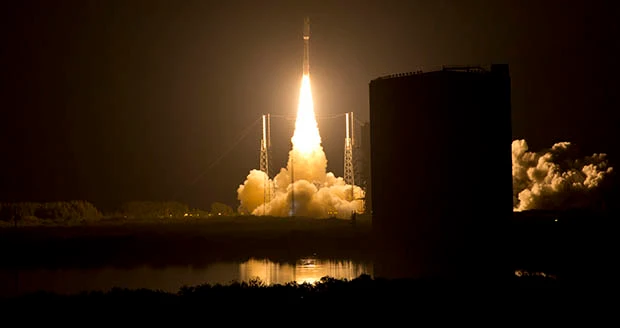
MUOS-3 launched at 8:04 p.m. EST Jan. 20, 2015, aboard a United Launch Alliance Atlas V rocket and will transition over the next nine days to reach its geosynchronous orbit location 22,000 miles above the Earth. The solar arrays and antennas will then be deployed, and on-orbit testing will start for subsequent turn-over to the Navy for test and commissioning to service.
“The ULA team is honored to deliver this critical mission into orbit for the U.S. Navy and U.S. Air Force with the support of our many mission partners,” said Jim Sponnick, ULA vice president, Atlas and Delta Programs. “The MUOS-3 spacecraft is the heaviest payload to launch atop an Atlas V launch vehicle. The Atlas V generated more than two and half million pounds of thrust at liftoff to meet the demands of lifting this nearly 7.5-ton satellite. Today’s launch was the 200th Atlas-Centaur launch – a very sincere congratulations to the many women and men responsible for the incredible success of the Centaur upper stage over the last 5 decades!”
This mission was launched aboard an Atlas V Evolved Expendable Launch Vehicle (EELV) 551 configuration vehicle, which includes a 5m diameter payload fairing along with five Aerojet Rocketdyne solid rocket motors attached to the Atlas booster. The Atlas booster for this mission was powered by the RD AMROSS RD-180 engine and the Centaur upper stage was powered by the Aerojet Rocketdyne RL10C-1 engine. This is ULA’s 1st launch in 2015, the 52nd Atlas V mission and the fifth Atlas V 551 launch.
The EELV program was established by the United States Air Force to provide assured access to space for Department of Defense and other government payloads. The commercially developed EELV program supports the full range of government mission requirements, while delivering on schedule and providing significant cost savings over the heritage launch systems.
MUOS, the Navy’s next-generation secure mobile satellite communications system, will eventually replace the legacy Ultra High Frequency (UHF) Follow-On system. MUOS satellites have two payloads to ensure access to UHF narrowband communications as well as new capabilities. MUOS’ advanced Wideband Code Division Multiple Access (WCDMA) payload incorporates commercial technology and a new waveform to provide users priority-based capacity.
Once fully operational, MUOS will provide 16 times the capacity of the legacy system. More than 50,000 terminals that are in the field today can be retro-fitted with WCDMA.
Prior to its launch, the MUOS-3 satellite was built at Lockheed Martin’s Sunnyvale, California, manufacturing facility. The satellite was shipped to Cape Canaveral Air Force Station on Nov. 5, 2014, and encapsulated into its launch fairing on Dec. 18.
The MUOS constellation is expected to provide warfighters full global coverage before the end of 2015. MUOS-1 and MUOS-2, launched respectively in 2012 and 2013, are already operational and providing high-quality voice communications. MUOS-4 is on track to launch later this year. The fourth and final required MUOS ground station also is expected to be delivered to the Navy early this year.
Lockheed Martin Space Systems, Sunnyvale, California, is the MUOS prime contractor and system integrator. The Navy's Program Executive Office for Space Systems and its Communications Satellite Program Office, San Diego, California, are responsible for the MUOS program.
Sources: Lockheed Martin, United Launch Alliance
Latest from Aerospace Manufacturing and Design
- The power of the plasma pen: Revolutionizing adhesion in aerospace manufacturing
- Mazak will show shops how to drive production at Dallas Open House
- Heavy-duty pneumatic flex locators
- Tacky Tape vacuum bag sealing tapes for aerospace composites continue a legacy
- Embraer’s Phenom 300 series is best-selling light jet for 14th consecutive year
- Expanded PushPull connector portfolio
- AEC is Meltio’s official sales partner
- Coolant-thru options for straight, 90-degree, universal live tools