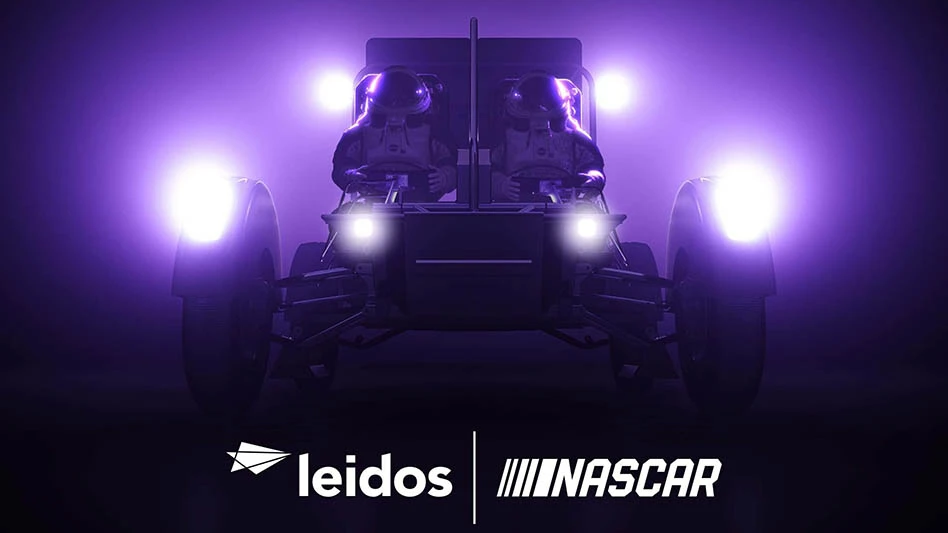
Leidos rendering
Leidos and its Dynetics team have announced their intention to compete in another moon race through a promotional partnership with NASCAR, a company well-known for high speeds. The partnership will be a collaboration between the two organizations in the areas of speed, safety, and reliability. Details of the collaboration as well as the design and technology of the Lunar Terrain Vehicle were unveiled at the Space Foundation's Space Symposium.
"We are thrilled to unveil our lunar vehicle design and to announce our exciting new promotional partnership," said Leidos CEO Roger Krone. "This groundbreaking collaboration between Leidos and NASCAR takes both companies into uncharted territory, just like we believe our rover will do for NASA and its astronauts. We aim to pave the way for human exploration of space and inspire the next generation of engineers, scientists, and innovators to reach for the stars."
"NASCAR partnering with Leidos couldn't make more sense when it comes to this vehicle," said Pete Jung, NASCAR senior vice president and chief marketing officer. "With both companies being known for exciting innovations in distinctive fields, this collaboration brings together ideas that normally don't meet in other developments. We are eager to watch this uniquely designed rover traverse different areas of the lunar surface."
Leidos is looking ahead to the next phases of NASA's Artemis program after the successful launch of Artemis I on Nov. 16, 2022. The company has submitted a bid for the Human Landing System Sustaining Lunar Development contract, a critical component of NASA's efforts to establish a sustainable presence on the moon. In addition, Leidos is currently working on the Universal Stage Adapter (USA) for NASA, a crucial piece of equipment that will enable the transport of large payloads, including the rover unveiled by the company.
"We are fully committed to supporting NASA's ambitious plans for lunar exploration," said Steve Cook, president of the Leidos Dynetics Group. "As an industry leader in space technology, we are uniquely positioned to help NASA achieve its objectives, providing everything from necessary crew mobility to workhorse flexibility for building a lunar base. We believe that our innovative solutions and unmatched expertise make us the ideal partner for NASA as it works to establish a sustainable presence on the moon and beyond."
The rover design is a masterclass in simplicity, harkening back to the engineering that made the Apollo missions successful, while incorporating modern innovations that prioritize sustainability. The rover's components have been meticulously designed to support the safety and well-being of astronauts as they drive across the lunar landscape. One innovation stands out: it supports male and female crew members across varying height and weight scales, promoting inclusivity in space exploration.
Leidos and its Dynetics team bring a wealth of experience to the table, with a long-standing reputation as trusted providers of advanced space systems and services to NASA. NASCAR boasts a powerful marketing engine and a passionate fan base, as well as a proven track record of developing high-performance race cars that push the boundaries of what's possible. Combining their strengths and expertise, this collaboration marks a new chapter in NASA's quest to explore the universe and push the boundaries of human achievement.
Roush Industries, of Livonia, Michigan, provides automotive design and manufacturing experience for the project. Other project partners include Collins Aerospace, Motiv Space Systems, Moog, A-P-T Research, Sophic Synergistics, and the Center for Advanced Vehicular Systems at Mississippi State University.
"NASCAR is excited about our promotional partnership with Leidos," Jung said. "Our partnership can take us to the moon – and potentially beyond."
Latest from Aerospace Manufacturing and Design
- The power of the plasma pen: Revolutionizing adhesion in aerospace manufacturing
- Mazak will show shops how to drive production at Dallas Open House
- Heavy-duty pneumatic flex locators
- Tacky Tape vacuum bag sealing tapes for aerospace composites continue a legacy
- Embraer’s Phenom 300 series is best-selling light jet for 14th consecutive year
- Expanded PushPull connector portfolio
- AEC is Meltio’s official sales partner
- Coolant-thru options for straight, 90-degree, universal live tools