Photo credit: AdobeStock_1777427257
The aerospace manufacturing sector is undergoing a profound transformation, driven by the adoption of Industry 4.0 technologies and the urgent need to overcome challenges such as supply chain vulnerabilities and skilled labor shortages. Automation, digitalization, and data-driven decision-making are no longer optional – they are essential for maintaining competitiveness and ensuring long-term resilience. As one of the most willing industries to trial new manufacturing technologies, aerospace manufacturers understand that data-driven insights are essential for improving processes and maintaining competitive advantage. This forward-thinking approach has made aerospace the perfect proving ground for intelligent fluid management solutions.
One of the most overlooked yet high-impact areas for digital transformation is metalworking fluid management. While investments in advanced machining centers and robotics have modernized many aspects of aerospace production, metalworking fluid management often remains manual and reactive. The following details how some aerospace manufacturers have already embraced intelligent fluid management systems to achieve significant improvements in productivity, product quality, and process consistency.
Trends in aerospace manufacturing
Today's aerospace manufacturers face a perfect storm of operational challenges. With increasing demand and record backlogs in commercial aircraft orders, manufacturers are under immense pressure to boost productivity and streamline operations, without compromising quality or cost efficiency. At the same time, machining aerospace materials demands ultra-precise machining conditions to ensure quality, performance, and safety.
In this high-stakes environment, fluid management has become a critical enabler of success. Coolants and lubricants play a vital role in achieving the precision, consistency, and efficiency required in modern aerospace manufacturing. Traditional fluid management approaches, characterized by manual monitoring, scheduled sampling, and reactive maintenance, are proving inadequate for these demands. Operators spend valuable time manually checking fluid concentrations, often discovering issues only after they’ve impacted production. Turnaround time required for routine laboratory analysis means problems are not addressed in real-time and persist for days before corrective action is taken. This reactive approach results in increased scrap rates, unplanned downtime, excessive fluid consumption, and compromised tool life.
The aerospace industry's current challenges amplify these issues. When machining critical components like turbine blades or landing gear assemblies, even minor fluid inconsistencies can result in costly rework. The high-value nature of aerospace components means that every piece of scrap represents significant financial impact, making real-time fluid management not just operationally important but financially critical.
Using intelligent fluid platforms to optimize fluids and processes
Adopting an automation platform to improve fluid management delivers measurable improvements across multiple operational metrics. Extended tool life is perhaps the most immediately visible benefit. By maintaining optimal fluid conditions, manufacturers typically see improvements in cutting tool performance, translating directly to reduced tooling costs, increased waste fluid, and decreased machine downtime for tool changes.
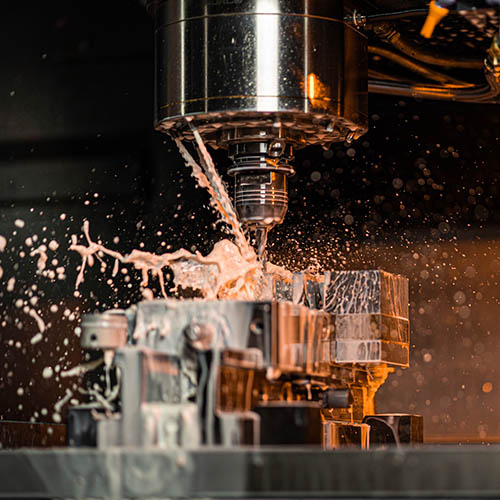
Optimizing fluid consumption represents another significant advantage. Real-time, automated measurement of fluids eliminates lab turnaround time and the guesswork on required dosing. Top-up systems can be automatically controlled based on these real-time measurements, ensuring precise concentrations are maintained without over or under consuming. When manufacturers choose to automate fluid management, they commonly report reduced fluid consumption from levelling out dosing vs. previous manual dosing. This can represent meaningful cost savings.
Quality improvements are equally impressive. Consistent fluid conditions lead to more predictable machining results, reducing scrap rates and rework requirements. The ability to maintain tight process control throughout production runs ensures that results are replicated across the entire batch, reducing quality-related delays and costs.
Perhaps most importantly, intelligent fluid management systems can significantly reduce unplanned downtime. By providing early warning of potential issues and enabling proactive maintenance, these systems help manufacturers avoid the costly production interruptions that plague traditional reactive approaches.
A global leader in industrial process fluids, Quaker Houghton has invested in research, development, and engineering combined with world-class fluids and applications expertise to develop the QH FLUID INTELLIGENCE™ platform. A fully digital and automated solution that is customizable, scalable, and easily integrated into the manufacturing system, the platform pairs hardware for automated monitoring and control with intuitive, user-friendly software to provide continuous, real-time, accurate, and actionable insights.
Quaker Houghton’s product portfolio carries OEM approvals across major aerospace platforms, reflecting years of rigorous testing and proven performance in the most demanding applications. These established partnerships create the foundation for seamless technology adoption, and allow manufacturers to digitally optimize fluid management, which can bring both process and product quality benefits. The decision to implement fluid intelligence systems builds on existing relationships where Quaker Houghton already serves as a key supplier.
Intelligent fluid management in action
The practical benefits of intelligent fluid management are best illustrated through real-world applications. One of the world’s largest landing gear manufacturers faced mounting pressure to reduce production costs while maintaining stringent quality requirements. Their primary machining operations involved drilling, milling, turning, and grinding of titanium and exotic alloys – processes that demanded precise coolant management to achieve required surface finishes and dimensional tolerances.
The challenge was significant: existing manual coolant management approach required constant operator attention and resulted in inconsistent fluid conditions. Concentration variations led to unpredictable tool life, while manual top-off procedures were labor-intensive and prone to error. The maintenance and facility manager recognized that optimizing coolant management could deliver substantial operational improvements.
By implementing QH FLUID INTELLIGENCE™ and installing QH FLUIDMONITOR GL™ devices, the manufacturer achieved remarkable results. The automated monitoring system provided continuous oversight of coolant concentration, enabling immediate detection and correction of variations. This resulted in extended coolant life, improved tool performance, and reduced scrap rates.
The quantifiable results were impressive: a 17% reduction in coolant concentration compared to traditional measurement systems, annual scrap savings of $20,000, and significant improvements in operational efficiency – all achieved without reducing machining speeds or compromising dimensional tolerances.
Another compelling example involves a global aerospace original equipment manufacturer (OEM) producing wing ribs who was expanding their North American facility with six new CNC machines. To support this expansion, they needed an automated fluid monitoring and control system to eliminate the manual top-up that consumed on average three hours per shift and required significant labor.
The six CNC machines consumed substantial volumes of metalworking coolant and required frequent additions to maintain proper concentration levels. The manual top-up was not only labor-intensive but resulted in inconsistent, fluctuating concentration, leading to production variability and quality concerns. The OEM needed a solution that could eliminate manual aspects while delivering more consistent concentration required for producing aerospace components.
Quaker Houghton installed six QH FLUIDCONTROL XMS™ units to provide comprehensive monitoring and control capabilities. These systems continuously recorded fluid concentration, conductivity, pH, temperature, and fluid levels for each CNC machine independently, providing real-time data and automated dosing responses. The implementation delivered transformational results. The automated system maintained stable coolant concentration while eliminating the labor-intensive manual top-up procedures. By optimizing coolant concentration stability which extended coolant lifespan, the manufacturer achieved improved tool life and enhanced operational efficiency.
Additionally, automating improved health and safety conditions by reducing worker exposure to metalworking fluids eliminated the physical demands of manual fluid management.
The future of aerospace manufacturing
The aerospace industry stands at a critical juncture. Intelligent fluid management represents an overlooked area that has significant impact on process and improvements of product quality, which is required for next-generation manufacturing operations. Manufacturers who embrace digital transformation today will establish competitive advantages that compound over time.
With ongoing technological upgrades, fluid management systems will integrate more deeply with broader manufacturing systems. Predictive analytics will make it possible to schedule maintenance proactively, while machine learning algorithms will increasingly optimize fluid parameters for specific applications and materials. The data generated by these systems will become increasingly valuable for process optimization and quality improvement initiatives. Fluid management, when digitized and automated, becomes a strategic lever for operational excellence. The future belongs to manufacturers who turn real-time data into actionable insights, and that future begins with intelligent fluid management.
Quaker Houghton
https://home.quakerhoughton.com
About the author: Nozi Hamidi is Global Director, Fluid Intelligence, Quaker Houghton
Latest from Aerospace Manufacturing and Design
- Dassault Aviation unveils the Falcon 10X
- Industrial round bumpers
- Defense Industry Trends webinar with Greenwich Capital Group
- Air Astana finalizes order for 25 Airbus A320neo family aircraft
- Syensqo showcases high-performance sustainable composites at JEC World 2026
- Multi-axis laser processing system
- Daher accelerates industrialization of thermoplastic composite upcycling
- Orizon Aerostructures deploys Flexxbotics platform