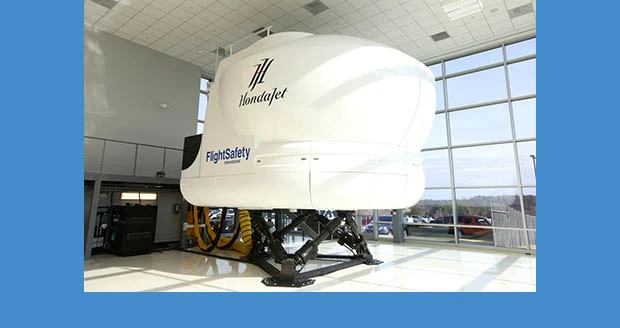
Greensboro, North Carolina – Honda Aircraft Co.’s first HondaJet flight simulator has been delivered and is currently being installed at the company’s world headquarters in Greensboro, North Carolina. The full motion, Level D simulator was developed in partnership with FlightSafety International and will be located at the HondaJet Training Center on the campus of Honda Aircraft.
“Pilot training is an important factor for safety, and we are putting significant effort and investment into flight training for all of our customers,” said Honda Aircraft Co. President and CEO Michimasa Fujino. “The HondaJet flight simulator will be an invaluable training tool in preparing pilots to operate the world’s most advanced light jet. It is part of a customized training program that will use the latest technologies to create a learning experience that is engaging and real to life.”
The HondaJet and its advanced flight deck were designed for simple, intuitive operation while achieving a high degree of safety. To enhance its state-of-the-art safety features, Honda partnered with FlightSafety International to develop the simulator and training program. As the world’s leading aviation training organization and supplier of flight simulators, FlightSafety operates the world’s largest fleet of full-flight simulators and delivers more than 1 million hours of instruction each year to pilots, technicians, and other aviation professionals.
The HondaJet flight simulator is a top-of-the-line training device that uses sophisticated software to precisely replicate the flight characteristics of the aircraft. The simulator will be capable of providing a full range of scenarios to help prepare and qualify pilots to safely operate the aircraft.
The simulator was constructed and assembled at FlightSafety’s manufacturing facility in Broken Arrow, Oklahoma, with the collaboration of Honda Aircraft. It will be certified to meet both the Federal Aviation Administration (FAA) and European Aviation Safety Agency (EASA) regulations.
The HondaJet light business jet aircraft incorporates an over-the-wing engine mount (OTWEM) configuration designed to improve performance and fuel efficiency by reducing aerodynamic drag. The OTWEM design also reduces cabin sound, minimizes ground-detected noise, and allows for a roomy cabin in its class, large baggage capacity, and aft lavatory. The HondaJet is powered by two GE Honda HF120 turbofan jet engines, and is equipped a Honda-customized Garmin G3000 next-generation, all-glass avionics system.
Source: Honda Aircraft Co.
Latest from Aerospace Manufacturing and Design
- The power of the plasma pen: Revolutionizing adhesion in aerospace manufacturing
- Mazak will show shops how to drive production at Dallas Open House
- Heavy-duty pneumatic flex locators
- Tacky Tape vacuum bag sealing tapes for aerospace composites continue a legacy
- Embraer’s Phenom 300 series is best-selling light jet for 14th consecutive year
- Expanded PushPull connector portfolio
- AEC is Meltio’s official sales partner
- Coolant-thru options for straight, 90-degree, universal live tools