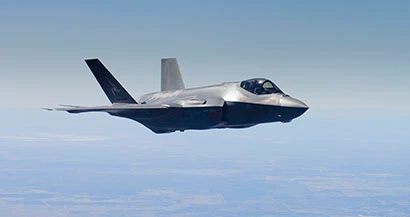
The first Lockheed Martin F-35C Lightning II Navy carrier variant (CV) aircraft, CF-6, arrived at Strike Fighter Squadron 101 located at Eglin Air Force Base, Fla., on Saturday. The jet is the U.S. Navy's first 5th-generation F-35 production aircraft.
Strike Fighter Squadron 101 will serve as the F-35C Fleet Replacement Squadron, training both pilots and maintainers. CF-6 will join a fleet of 12 F-35A conventional takeoff and landing (CTOL) jets and 13 F-35B short takeoff and vertical landing (STOVL) jets already assigned to Eglin. Later this year, four additional CVs will join the fleet.
U.S. Navy test pilot Lt. Cmdr. Chris Tabert flew CF-6 on its ferry flight. Last year, he became the first military test pilot to fly all variants of the F-35.
"We are committed to the Navy's vision for the F-35 that will revolutionize forward based combat power in current and future threat environments," says Lorraine Martin, Lockheed Martin executive vice president and F-35 program general manager. "The F-35 represents the new standard in weapon systems integration, maintainability, combat radius, and payload that brings true multi-mission capability to the Navy."
The F-35C, the U.S. Navy and Marine Corps' CV, has larger wings and more robust landing gear than the other F-35 variants. The CV has the greatest internal fuel, at 19,624 lb, making it suitable for catapult launches and fly-in arrestments aboard naval aircraft carriers. Its wingtips fold to allow for capacity and, like the F-35B, the C-variant uses probe-and-drogue refueling.
Three distinct variants of the F-35 will replace the A-10 and F-16 for the U.S. Air Force, the F/A-18 for the U.S. Navy, the F/A-18 and AV-8B Harrier for the U.S. Marine Corps, and a variety of fighters for at least 10 other countries. The U.S. Navy plans to declare Initial Operational Capability with the CV in 2019.
Latest from Aerospace Manufacturing and Design
- The power of the plasma pen: Revolutionizing adhesion in aerospace manufacturing
- Mazak will show shops how to drive production at Dallas Open House
- Heavy-duty pneumatic flex locators
- Tacky Tape vacuum bag sealing tapes for aerospace composites continue a legacy
- Embraer’s Phenom 300 series is best-selling light jet for 14th consecutive year
- Expanded PushPull connector portfolio
- AEC is Meltio’s official sales partner
- Coolant-thru options for straight, 90-degree, universal live tools