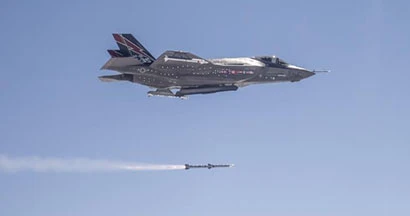
An F-35A conventional takeoff and landing (CTOL) aircraft has completed the first in-flight missile launch of an AIM-120 C5 AAVI (AMRAAM Air Vehicle Instrumented). The flight was conducted by U.S. Air Force Lt. Col. George "Boxer" Schwartz. The aircraft, known as AF-1, launched the missile over the Point Mugu Sea Test Range from the internal weapons bay on June 7.
This is the first launch where the F-35 and AIM-120 demonstrated a successful launch-to-eject communications sequence and fired the rocket motor after launch - paving the way for targeted launches later this year in support of Block 2B fleet release capability.
Recently, the Air Force F-35A variant has seen significant development in training and operations, to include: the beginning of pilot training at Eglin Air Force Base, the delivery of the first operational test aircraft to Edwards and Nellis Air Force Bases, the first operational pilot aerial refueling and the completion of high angle of attack testing.
"It's a testament to the entire military-industry test team. They've worked thousands and thousands of hours to get to this point- to where we are today," says Schwartz, who in addition to his role as a test pilot serves as the F-35 Integrated Test Force (ITF) Director at Edwards. "It's fantastic to see that it's all paid off. We're rolling into a lot of additional weapons work in the coming months to put that expanded capability on the aircraft."
The F-35A 5th Generation fighter is designed to carry a payload of up to 18,000 lb using 10 weapon stations. The F-35A features four internal weapon stations located in two weapon bays to maximize stealth capability. The CTOL aircraft can also utilize an additional three external weapon stations per wing if required.
The U.S. Air Force has established an F-35A initial operating capability (IOC) target date of December 2016. By this date, the Air Force will have fielded an operational squadron with 12 or more aircraft with airmen trained and equipped to conduct basic close air support, interdiction and limited suppression and destruction of enemy air defense operations in a contested environment.
Moving into the active phase of weapons test is another large step toward delivering Block 2B software capability that will enable initial combat deployment. "We've spent years working on the design of the aircraft, and many months ensuring that weapons could be contained within the aircraft and dropped as designed. This event is the result of tremendous effort and collaboration in the F-35 enterprise, and marks a turning point in F-35 capabilities; the AIM-120 launch is one small, but critical increment toward proving combat capability," says Charlie Wagner, F-35 Weapons Director.
The fifth-generation F-35 Lightning II combines advanced stealth with fighter speed and agility, fully fused sensor information, network-enabled operations and advanced sustainment. Three distinct variants of the F-35 will replace the A-10 and F-16 for the U.S. Air Force, the F/A-18 for the U.S. Navy, the F/A-18 and AV-8B Harrier for the U.S. Marine Corps, and a variety of fighters for other countries.
Lockheed Martin photo by Matthew Short
Latest from Aerospace Manufacturing and Design
- The Lee Company opens Innovation Center
- Precision XY gantry system
- Archer to test Starlink onboard its Midnight air taxis
- System eliminates cage-creep in sliding bearings
- Bodo Möller Chemie signs worldwide supply contract with Airbus
- Sandvik Coromant's CoroTurn Plus turning adapter
- ZOLLER Technology Days & Smart Manufacturing Summit May 13-14, 2026 in Ann Arbor, Michigan
- Walter's TC620 Supreme multi-row thread mill family