The European Space Agency (ESA) has selected the baseline configuration for its next-generation launch vehicle, Ariane 6.
The objective of Ariane 6 is to ensure a guaranteed autonomous access to space for Europe, while lowering costs and reducing required support.
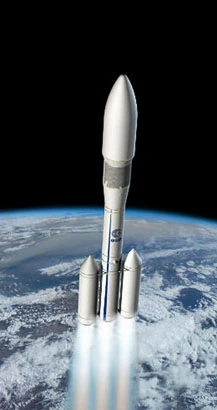
Powered by two solid-fuelled lower stages, the Ariane 6 will feature the liquid-fuelled upper-stage that is currently under development as an upgrade for the existing Ariane 5 vehicle.
This concept has been selected following trade-off studies for six months, conducted by a "plateau projet" integrating industrial teams comprising Astrium, Avio, Herakles, and the participation of Safran, MT Aerospace, and others, under ESA contract.
The new rocket will have a lifting capacity of between 3t and 6.5t in equivalent to geostationary transfer orbit (GTO) occupied by telecommunication satellites. It will launch one spacecraft at a time, compared with two routinely orbited by the Ariane 5, but at a lower cost per flight, Ariane 6’s intended advantage.
The configuration of two stages using solid rocket motors and one using cryogenic propulsion was selected by consensus based on the criteria of operations costs, time to market, and development costs.
Providing synergies with the Vega evolution perspectives, the "Multi P linear" concept is based on a lower composite of four motors, each loaded with approximately 135t of solid propellant.
An in-line arrangement of three motors will serve as the first stage, while the fourth will be mounted above as the second stage.
The third stage will be a modified version of the Ariane 5 ME upper stage, equipped with the Vinci engine and specific propellant tanks.
The 5.4m diameter payload will be capable of accommodating the similar number of satellites as Ariane 5.
ESA will consult with industry to accumulate competing ideas on key packages of the new launch system.
Consolidation of the current Phase A will take place at the preliminary requirements review (PRR) in October 2013.
Latest from Aerospace Manufacturing and Design
- Archer to test Starlink onboard its Midnight air taxis
- System eliminates cage-creep in sliding bearings
- Bodo Möller Chemie signs worldwide supply contract with Airbus
- Sandvik Coromant's CoroTurn Plus turning adapter
- ZOLLER Technology Days & Smart Manufacturing Summit May 13-14, 2026 in Ann Arbor, Michigan
- Walter's TC620 Supreme multi-row thread mill family
- ThermOmegaTech achieves CMMC Level 2 C3PAO certification
- One-touch precision flex locators