Photo credit: Greene Tweed Co.
The following offered responses to Aerospace Manufacturing and Design’s questions:
Dr. Ronald R Campbell, PhD, Senior Technical Advisor, Greene Tweed
Becky Petry, Applications Engineer, Greene Tweed
Andrew Clarke, CEng, Applications Engineer – Sealing Systems, Greene Tweed
What are the differences in various types of sustainable aviation fuel (SAF) and how do these variants affect common elastomers?
Sustainable Aviation Fuels (SAFs) are renewable alternatives to traditional jet fuels, intended to reduce carbon emissions. SAFs are produced from a variety of renewable feedstocks, including biomass, algae, animal fats, vegetable oils, and agricultural residues like corn stalks. The ASTM D7566 standard outlines eight approved SAF pathways, enabling the production of sustainable fuels tailored to both environmental goals and fuel performance requirements.
Within SAF, there are different formulations, including Synthetic Aromatic Kerosene (SAK) and Synthetic Paraffinic Kerosene (SPK). These variants differ primarily in their aromatic content [benzene (ring) hydrocarbons], which plays a vital role in determining their compatibility with elastomers commonly used in aerospace fuel systems:
- SAK contains a high level of aromatics, which are essential for maintaining the performance of certain elastomers, such as those used in seals and gaskets. Aromatics help elastomers retain their flexibility and prevent excessive swelling or weakening.
- SPK has no aromatic content, making it a cleaner-burning fuel. However, its lack of aromatics can lead to challenges with elastomer compatibility, such as swelling or reduced sealing performance.
Both SAK and SPK formulations play a critical role in the adoption of SAF. While SAK’s high aromatic content supports compatibility with traditional elastomers, SPK offers a cleaner-burning alternative with fewer emissions but requires careful consideration of elastomer performance. Advanced materials like FKM seals provide a reliable solution across SAF blends, ensuring safety and performance without compromising sustainability goals. As the aviation industry continues its transition toward greener fuels, understanding the nuances of SAF formulations and their impact on materials will be key to a seamless shift toward more sustainable skies.
Which form of SAF – SAK or SPK – is more in use or likely to come into use?
Currently, SPK is more widely adopted and is set to play a key role in the future of aviation. The diversity of feedstocks approved under ASTM D7566 highlights the broad range of sources available for SPK production. Aircraft manufacturers are also making strides toward sustainability, with plans to design aircraft capable of operating on 100% SPK by 2030. Certain SPK feedstocks are already proving to be the dominant choice for SAF.
We worked with Virant to source and test SAK (which is 97% aromatic) – a material with a high aromatic content (97%) derived from algae. This product was specifically developed to blend with approximately 80% SPK, ensuring the correct aromatic balance needed for a drop-in fuel compatible with nitrile seals exposed to jet fuel. While SAK is not intended to be used as a standalone fuel, it serves as a critical blending component. A mixture of 80% SPK and 20% SAK creates a 100% sustainable fuel option, eliminating the need for petroleum-based jet fuel while maintaining performance and reliability.
Where are elastomer seals used and for what purpose?
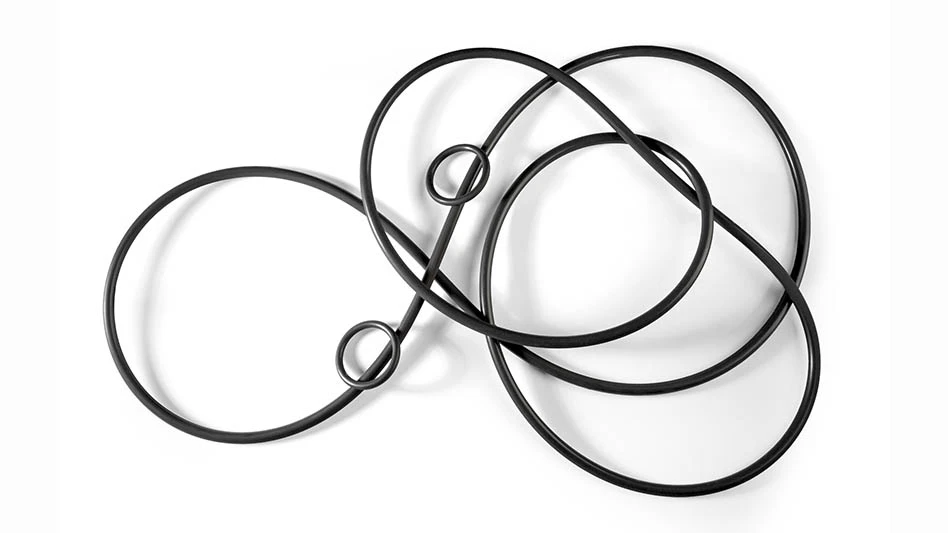
In aerospace applications, elastomer seals are critical components used in fuel systems, hydraulic systems, and engines to prevent leaks and ensure safety. Their primary purpose is to create a reliable barrier that prevents leaks, withstands elevated temperatures, and resists chemical degradation.
What material used in commercial applications underperforms with SAF and in what ways (swelling, weakening) and under what conditions?
Fluorosilicone elastomers (FVMQ), such as Greene Tweed’s 409 compound, showed underperformance in certain conditions:
- Hardness Change: FVMQ materials exhibited greater and/or inconsistent hardness reduction when exposed to SAF fluids.
- Weakening: Prolonged exposure to dry-out conditions or fuel switching (e.g., from conventional jet fuel to SAF) led to reduced sealing performance and dimensional instability.
Based on the variance in results between the different types of SAFs used, we recommend further application testing of any FVMQ compound in the specific SAF fluid intended for use. In contrast, under the same test conditions Greene Tweed’s fluorine-based elastomers (FKM compounds 665, 731, and 772) demonstrated good compatibility and consistent performance.
How widespread is the use of seals that use this material?
FVMQ (the material which underperformed during testing) represents a choice for static fuel applications that require good sealing performance over a broad temperature range. Few material options were historically available that could offer excellent levels of sealing performance at very cold temperatures (i.e. below -54°C or -65°F). However, newer grades of FKM material are also capable of performing well at these cold temperatures.
Are substitute materials available (and approved by the FAA, EASA, etc.) to replace the underperforming seal materials?
As mentioned above, newer grades of FKM material (notably those compliant against AMS7379 and AMS7410 industry specifications) can perform well at very cold temperatures. As such, they can meet the operating temperature envelope that only an FVMQ material can offer. In addition, FKM materials also typically cost somewhat less than FVMQs. FKM materials can therefore represent an attractive alternative to an FVMQ material.
It should be noted that if a type of sealing product is replaced within an aircraft system, it is the responsibility of aircraft system manufacturers to qualify the replacement and demonstrate an equivalent level of performance.
Do FKM seals cost more?
The cost impact would be from having to replace nitrile seals with the FKM seals due to the higher cost of FKM material. As mentioned earlier nitrile seals require some aromatic content, so the blending of aromatics or switching to FKM seals would be a cost consideration.
Is the supply chain for the substitute material challenged?
The supply chain for advanced elastomer materials like FKM is currently stable, however, fluctuations are always possible depending on factors like increased demand. Greene Tweed’s global manufacturing and distribution network ensures a reliable supply of high-performance elastomers to meet industry needs.
What is Greene Tweed’s expertise in supplying elastomers for SAF (can cover research, testing, verification, manufacturing or distribution strengths).
As a global leader in advanced materials and high-performance solutions, with decades of experience in elastomer technology, our expertise spans multiple areas, including advanced material science capabilities in research and development.
We follow this with comprehensive testing and verification protocols to ensure our materials meet or exceed industry standards. For this particular application, we conducted a comprehensive study to evaluate the compatibility of fluorine-based elastomer seals with various SAF blends, including SPK and SAK. The seals were tested under accelerated aerospace conditions, such as temperatures up to 120°C and prolonged SAF exposure, to ensure their reliability in real-world applications.
Our manufacturing facilities also enable us to produce high-quality elastomers at scale, while our robust global distribution network ensures efficient delivery to customers worldwide.
Proving seal compatibility with SAFs through rigorous testing ensures that existing aircraft and systems can safely transition to these fuels without costly overhauls, paving the way for a more sustainable future in aviation while maintaining safety and reliability standards.
Greene Tweed Co.
https://www.gtweed.com
Latest from Aerospace Manufacturing and Design
- Join the automation conversation
- Enhanced visitor experience highlighted at TMTS 2026
- This week: Tube bending and workholding solutions to implement now
- Dassault Aviation unveils the Falcon 10X
- Industrial round bumpers
- Defense Industry Trends webinar with Greenwich Capital Group
- Air Astana finalizes order for 25 Airbus A320neo family aircraft
- Syensqo showcases high-performance sustainable composites at JEC World 2026