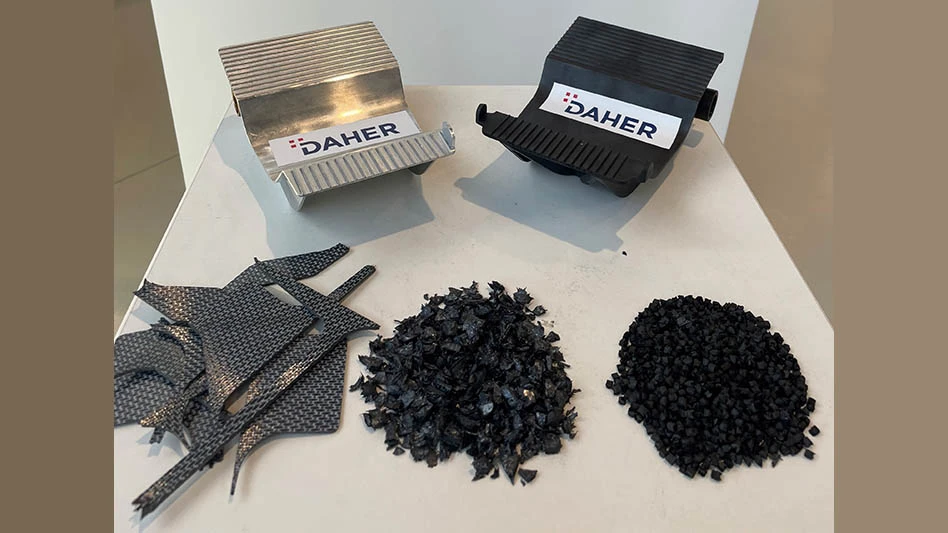
Photo credit: Daher
At the JEC World 2026 trade show, Daher is confirming its role as a pioneering industrial player in the upcycling of thermoplastic composites. As one of the first companies to commit to industrial-scale deployment, the Daher Group is preparing to make these upcycled materials available to manufacturers that face challenges related to production ramp-up, as well as material sovereignty and decarbonization. Two of Daher’s projects have been recognized with JEC Innovation Awards.
For more than 10 years, Daher has been investing in mastering thermoplastic composites to meet the requirements of aeronautical programs, including structural weight reduction, lower carbon footprint, and high-rate production. The 2026 JEC Award won in the Aeronautics (Parts) category for its highly loaded thermoplastic wing rib, illustrates this expertise.
The Daher Group is taking a new step forward by structuring a complete upcycling value chain, from scrap collection to reintegration of the material into production. The objective is to reintroduce these materials into new manufacturing cycles, delivering environmental benefits and enhanced industrial sovereignty.
Upcycling thermoplastic scrap: An industrialized technical material
The first pillar of this strategy focuses on upcycling scrap generated during the production of thermoplastic composite parts. Working closely with its Saint-Aignan-de-Grandlieu plant (in France’s Loire-Atlantique region) and its Shap’in technology center, Daher has implemented a structured process: production scrap is collected on site, ground up at Shap’in, and then transformed into a semi-finished product.
Now, 100% of pure carbon polyphenylene sulfide (PPS) scrap is upcycled through this process. The resulting semi-finished product is a pellet containing 56% carbon fiber. Derived from fibers that originally were continuous and reprocessed into short fibers, it offers high mechanical performance – including excellent temperature resistance and strong resistance to moisture and chemical exposure. Particularly well suited to injection molding processes, this material enables the manufacture of complex technical parts for demanding environments.
The scale-up of this process results in an estimated production capacity of four to eight metric tons per year of carbon PPS pellets. Daher currently has 1.5 metric tons available for sale and is actively working on customer applications, including those beyond the aeronautics sector. Recently, using the same scrap material, the Daher Group developed a filament for additive manufacturing, opening new opportunities for 3D printing of technical parts. A part produced using this filament is displayed at the Daher booth at JEC World 2026.
Upcycling end-of-life aeronautical parts
In addition to production scrap upcycling, Daher also is applying its expertise to end-of-life aeronautical parts made from thermoplastic composites.
This approach was recognized at the 2026 JEC Innovation Awards, with a second award-winning project carried out in partnership with Airbus, Toray Advanced Composites, and Tarmac Aerosave. The project involved recycling thermoplastic composite panels from an A380, cutting them and reintegrating them into the production of new parts for the A320neo. The resulting part is displayed at the Daher booth at JEC World 2026.
This demonstration confirms Daher’s ability to master thermoplastic composite upcycling in all its forms, from production scrap to end-of-life structures, and to prepare these solutions for industrial-scale deployment.
“For more than 10 years, we’ve invested in thermoplastic composites to meet aircraft manufacturers’ requirements in terms of production rates, weight reduction, and performance,” explains Julie Vaudour, the Deputy Research & Development Director at Daher. “Today, we are taking a further step by industrializing materials derived from upcycling. This capability allows us to optimize the use of a strategic material, strengthen our material autonomy, and open new application opportunities – in aeronautics and beyond.”
Latest from Aerospace Manufacturing and Design
- Orizon Aerostructures deploys Flexxbotics platform
- Knurling and marking tools
- Bell completes CDR on DARPA SPRINT X-plane program
- Small finishing machine for 3D-printed metal parts
- Pivotal launches eVTOL emergency response in North Carolina
- Assemble-to-order program for gundrilling machines
- #83 Manufacturing Matters - Workholding Roundtable
- Increase speed, productivity, and agility with automation technology