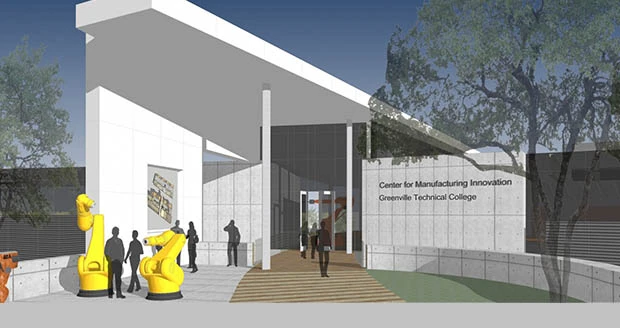
Center for Manufacturing Innovation entryway rendering. Credit: LS3P
Greenville, South Carolina – Clemson University and Greenville Technical College officials have broken ground for a $25 million center that will advance the manufacturing workforce and serve the automotive, transportation, and other high-tech sectors.
The Center for Manufacturing Innovation (CMI) is a collaboration between a leading research university, an innovative technical college, and manufacturers to create a center that enhances the development and implementation of advanced manufacturing technologies.
The primary goal for CMI is to increase the number of skilled workers for manufacturing to close the skills gap that has hampered the progress of many upstate employers.
CMI, to be located adjacent to the Clemson University International Center for Automotive Research Technology Neighborhood 1, will offer education designed to meet industry needs. It will include dual-credit programs in partnership with Greenville County Schools, articulations that promote students’ progress from associate’s to bachelor’s degrees, and workforce training and certificate programs that increase the qualifications of manufacturing employees.
Research for innovation in advanced manufacturing and future technologies related to advanced manufacturing will be incorporated into instruction. CMI will also include a Manufacturing Honors College, expected to be the first of its kind.
The center will engage K-12 students and show them the possibilities that exist in advanced manufacturing careers through dual enrollment programs, tours, camps, and open houses. Students also will benefit from internships and apprenticeships that allow them to gain practical experience working alongside experienced engineers, faculty, and staff.
CMI is designed to change perceptions about manufacturing with architectural features that will instantly engage students. The entryway will provide observation points where a visitor can view simulated advanced manufacturing environments and interactive displays that will educate and inspire.
From an economic development perspective, upstate leaders have said that the economic development race will be won by communities that offer the services manufacturers need. To help companies compete globally, employers need a flexible, highly skilled workforce equipped to maximize new technologies, adapt to evolving production processes and work organization models, and solve problems rapidly.
The center will offer space that helps companies start up or relocate and will provide flexible space where manufacturers can create prototypes and teach their current employees new skills to keep them on the cutting edge of improvements in technology.
The idea for the campus began with the needs of employers. As the concept has been developed, leaders with area manufacturers BMW, Michelin, GE, Bosch Rexroth, ADEX Machining Technologies, League Manufacturing, JTEKT Koyo, Fabri-Kal, SpecFab Services, Master PT, Standard Motor Products, and others have voiced strong support for the project and have provided input that has allowed plans for CMI to take shape.
Clemson University President James P. Clements said Clemson is proud to continue its strong relationship with Greenville Technical College.
“The Center for Manufacturing Innovation is another great example of the partnership between Clemson and Greenville Tech,” Clements said. “This center has the potential to transform manufacturing education in the Upstate, which will make a huge difference that will eventually be felt across South Carolina, and I am thankful for all of the people who worked to make this happen.”
“Our Center for Manufacturing Innovation represents a game-changing approach to education,” said Keith Miller, president of Greenville Technical College. “We will close the skills gap by creating the skills needed for new employees and improving the skills of the current workforce. And we will fully integrate education from the K-12 system to the two-year college to the four-year university level, working together to better meet the needs of manufacturers in order to advance our economy.”
Source: Clemson University
Latest from Aerospace Manufacturing and Design
- The power of the plasma pen: Revolutionizing adhesion in aerospace manufacturing
- Mazak will show shops how to drive production at Dallas Open House
- Heavy-duty pneumatic flex locators
- Tacky Tape vacuum bag sealing tapes for aerospace composites continue a legacy
- Embraer’s Phenom 300 series is best-selling light jet for 14th consecutive year
- Expanded PushPull connector portfolio
- AEC is Meltio’s official sales partner
- Coolant-thru options for straight, 90-degree, universal live tools