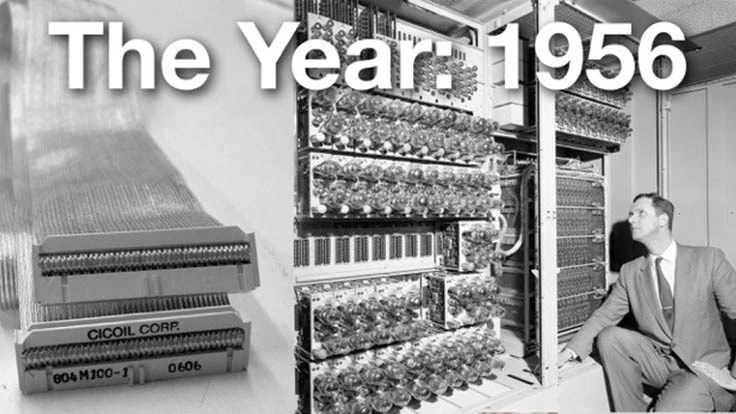
Valencia, California – On March 5, 2016, Cicoil celebrated the 60th year of its founding as a manufacturer of innovative multi-conductor cables. Cicoil also has another 60th anniversary to celebrate this year – the development of the IDC Ribbon Cable in August 1956.
Due to advanced developments of mainframe computer products, the need arose for a cable that could provide flexibility in tight spaces, contain many wires within one cable, and offer continuous reliability over long term operation. In 1956, the task was considered almost impossible, However, Cicoil’s engineers figured out a way to use liquid silicone rubber to mold a very thin flat cable containing multiple conductors of the same size, while at the same time controlling the spacing of each internal copper wire. Since the cable looked like a flat ribbon or a tape, Cicoil named it Ribbon Cable, and the IDC Ribbon Cable was born.
The new, flat IDC Ribbon Cable product allowed companies like IBM, Sperry/Univac, Honeywell, GE, and NCR to move forward and replace bulky, stiff round cables with sleek, flexible ribbon cables. This innovative development helped in the advancement of mainframe computers, card readers, keypunch systems, and paper tape reader machines.
The mainframe industry wasn’t the only one in need of a flat ribbon cable. In the 1960s, NASA needed a mission-critical, lightweight cable which would be incorporated into a biomedical cable harness. Fortunately for NASA, Cicoil had developed its IDC Ribbon Cable a few years earlier and was able to meet all of the rigorous requirements for a space flight cable. As a result, the lightweight ribbon cables were integral to the first American orbit of the Earth (John Glenn), first American space walk in 1965 (Edward White), and the lunar landing in 1969 (Neil Armstrong and Buzz Aldrin).
To meet the needs of its growing, diverse customer base, Cicoil developed a new extrusion process in 1998, which allowed it to manufacture continuous lengths of flat cable, including the IDC Ribbon Cable with a unique, crystal clear material named Flexx-Sil. Representing a quantum leap from Cicoil’s original molded flat cables, the new Flexx-Sil material and extrusion process created a wide variety of high-performance, cost-effective flat cable solutions for semiconductor, motion control, consumer, mil/aero and medical automation industries worldwide.
Source: Cicoil
Due to advanced developments of mainframe computer products, the need arose for a cable that could provide flexibility in tight spaces, contain many wires within one cable, and offer continuous reliability over long term operation. In 1956, the task was considered almost impossible, However, Cicoil’s engineers figured out a way to use liquid silicone rubber to mold a very thin flat cable containing multiple conductors of the same size, while at the same time controlling the spacing of each internal copper wire. Since the cable looked like a flat ribbon or a tape, Cicoil named it Ribbon Cable, and the IDC Ribbon Cable was born.
The new, flat IDC Ribbon Cable product allowed companies like IBM, Sperry/Univac, Honeywell, GE, and NCR to move forward and replace bulky, stiff round cables with sleek, flexible ribbon cables. This innovative development helped in the advancement of mainframe computers, card readers, keypunch systems, and paper tape reader machines.
The mainframe industry wasn’t the only one in need of a flat ribbon cable. In the 1960s, NASA needed a mission-critical, lightweight cable which would be incorporated into a biomedical cable harness. Fortunately for NASA, Cicoil had developed its IDC Ribbon Cable a few years earlier and was able to meet all of the rigorous requirements for a space flight cable. As a result, the lightweight ribbon cables were integral to the first American orbit of the Earth (John Glenn), first American space walk in 1965 (Edward White), and the lunar landing in 1969 (Neil Armstrong and Buzz Aldrin).
To meet the needs of its growing, diverse customer base, Cicoil developed a new extrusion process in 1998, which allowed it to manufacture continuous lengths of flat cable, including the IDC Ribbon Cable with a unique, crystal clear material named Flexx-Sil. Representing a quantum leap from Cicoil’s original molded flat cables, the new Flexx-Sil material and extrusion process created a wide variety of high-performance, cost-effective flat cable solutions for semiconductor, motion control, consumer, mil/aero and medical automation industries worldwide.
Source: Cicoil
Latest from Aerospace Manufacturing and Design
- Archer to test Starlink onboard its Midnight air taxis
- System eliminates cage-creep in sliding bearings
- Bodo Möller Chemie signs worldwide supply contract with Airbus
- Sandvik Coromant's CoroTurn Plus turning adapter
- ZOLLER Technology Days & Smart Manufacturing Summit May 13-14, 2026 in Ann Arbor, Michigan
- Walter's TC620 Supreme multi-row thread mill family
- ThermOmegaTech achieves CMMC Level 2 C3PAO certification
- One-touch precision flex locators