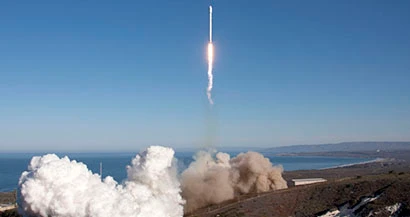
Magellan Aerospace launched its first MAC-200 bus on the Cascade SmallSat and IOnospheric Polar Explorer (CASSIOPE) satellite from Vandenberg Air Force Base, Calif., on a SpaceX Falcon 9 launch vehicle on Sunday, Sept. 29, 2013.
CASSIOPE is a multi-purpose mission carrying eight instruments to conduct space environment research (collectively called e-POP) and advanced telecommunications technology demonstration (termed Cascade). Its five secondary payloads were delivered into their intended orbits.
James S. Butyniec, president and CEO of Magellan Aerospace said, “The successful launch of CASSIOPE yesterday is a great accomplishment that we celebrate with the Canadian Space Agency, MacDonald, Dettwiler, and Associates Ltd. (MDA), and all of the Canadian industrial contributors and scientists who contribute to advancing Canada’s space technology capabilities.”
In 2005, Magellan won a competitive process to develop a satellite bus with a flexible architecture that could be tailored to meet mission-specific requirements for Canada’s future space missions including CASSIOPE.
The MAC-200 bus was designed to accommodate a range of mission requirements, instrument interfaces, and launcher environments in a cost effective manner. The MAC-200 utilizes a fully redundant crossstrapped architecture that is capable of providing high reliability for mission lifetimes of more than 7 years.
The CASSIOPE satellite bus was designed and built in Magellan Aerospace, Winnipeg. Magellan then supported both the integration and test of the e-Pop and Cascade payloads in Winnipeg and the spacecraft level testing at the David Florida Laboratory (DFL) in Ottawa, Ontario, Canada, under contract to MDA.
In addition to the design, manufacture, and AIT of the bus for CASSIOPE, Magellan also designed and developed the in-flight computer and custom-build data handling card, flight software, mechanical and electrical ground support equipment, Command and Data Handling (C&DH) unit, elements of the e-POP payload, as well as the mechanically-designed deployable booms.
The 22-story Falcon 9 rocket, built and flown by Space Exploration Technologies, better known as SpaceX, lifted off from Space Launch Complex-4 at Vandenberg. The CASSIOPE Canadian science satellite was nestled inside the rocket's 17ft (5m) diameter nose cone.
The upgraded Falcon 9 has engines that are 60% more powerful than previous versions, longer fuel tanks, new avionics and software, and other features intended to boost lift capacity and simplify operations for commercial service.
Falcon 9's next launch, scheduled for next month from Cape Canaveral Air Force Station in Florida, is planned to put a communications satellite into orbit for SES World Skies.
Sources: Magellan Aero, SpaceX
Latest from Aerospace Manufacturing and Design
- Archer to test Starlink onboard its Midnight air taxis
- System eliminates cage-creep in sliding bearings
- Bodo Möller Chemie signs worldwide supply contract with Airbus
- Sandvik Coromant's CoroTurn Plus turning adapter
- ZOLLER Technology Days & Smart Manufacturing Summit May 13-14, 2026 in Ann Arbor, Michigan
- Walter's TC620 Supreme multi-row thread mill family
- ThermOmegaTech achieves CMMC Level 2 C3PAO certification
- One-touch precision flex locators