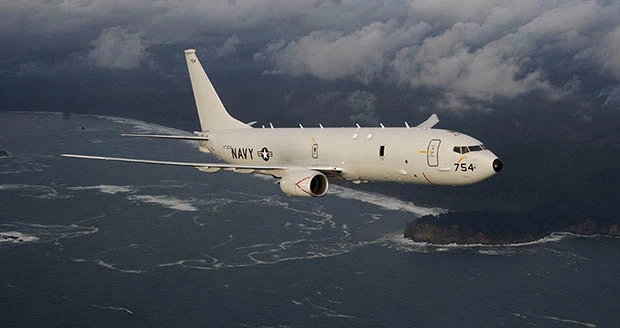
Seattle, Washington – Boeing will provide the first P-8A Poseidon maritime surveillance aircraft for Australia and additional P-8As for the U.S. Navy following a $1.49 billion contract award from the Navy for 13 aircraft.
The order includes nine aircraft for the U.S. Navy and four Poseidon aircraft for the Royal Australian Air Force (RAAF), a long-time partner to the U.S. Navy on P-8A development.
“By working together since the early stages of P-8A development, the U.S. and Australia have created one airplane configuration that serves the needs of both countries,” said Capt. Scott Dillon, U.S. Navy P-8 program manager. “The U.S. and Australian P-8As will be able to operate with each other effectively and affordably for decades to come.”
This latest award puts Boeing on contract to build the Navy’s second lot of full-rate production aircraft, bringing the U.S. Navy’s fleet total to 62 P-8As. Boeing has delivered 28 Poseidons to date.
Based on Boeing’s Next-Generation 737-800 commercial airplane, the P-8A offers advanced anti-submarine, anti-surface warfare and intelligence, surveillance, and reconnaissance capabilities. The Navy has deployed the first two P-8A patrol squadrons since operations started in 2013.
Australia’s participation in the P-8 program began in 2009 when the government signed the first in a series of memorandums of understanding to work with the U.S. Navy on system design and development. The U.S. Navy and the RAAF also established a joint program office that operates at Naval Air Station Patuxent River, Maryland.
Production of the first Australian P-8A will begin later this year, with delivery to the RAAF scheduled for 2016. Boeing will also provide the RAAF with a complete training system for the P-8A, using simulators to train pilots and mission crews to operate the aircraft, its sensors, communications, and weapons systems without relying on costly live flights.
Source: Boeing Defense, Space & Security
Latest from Aerospace Manufacturing and Design
- The power of the plasma pen: Revolutionizing adhesion in aerospace manufacturing
- Mazak will show shops how to drive production at Dallas Open House
- Heavy-duty pneumatic flex locators
- Tacky Tape vacuum bag sealing tapes for aerospace composites continue a legacy
- Embraer’s Phenom 300 series is best-selling light jet for 14th consecutive year
- Expanded PushPull connector portfolio
- AEC is Meltio’s official sales partner
- Coolant-thru options for straight, 90-degree, universal live tools