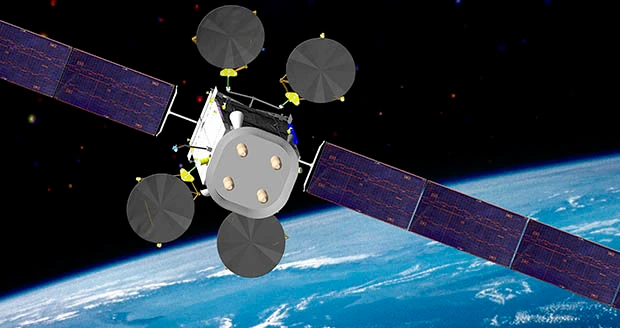
El Segundo, California – Boeing has completed production of the world’s first all-electric propulsion satellites as preparations continue to launch the satellites, as a vertically stacked pair, in February.
The Boeing 702SP (small platform) satellites are lightweight, and provide more options for movement to different orbital positions. The 702SP is one of three new satellite designs Boeing has introduced in four years, the others being the 702MP and 502 Phoenix.
“We are the first aerospace company to develop this highly efficient and flexible all-electric satellite, and we completed the first two 702SPs less than three years after contract award,” said Mark Spiwak, president of Boeing Satellite Systems International. “With more than 210,000 hours of on-orbit experience with electric propulsion, we recognized that this highly efficient, lighter weight propulsion system would translate into cost savings for our customers.”
Patented Boeing technology allows two all-electric satellites to be stacked and launched together. The ABS-3A satellite for Bermuda-based ABS and the EUTELSAT 115 West B satellite for Paris-based Eutelsat are scheduled to be launched on a SpaceX Falcon 9 rocket in February 2015.
Source: Boeing Defense, Space & Security
Latest from Aerospace Manufacturing and Design
- The power of the plasma pen: Revolutionizing adhesion in aerospace manufacturing
- Mazak will show shops how to drive production at Dallas Open House
- Heavy-duty pneumatic flex locators
- Tacky Tape vacuum bag sealing tapes for aerospace composites continue a legacy
- Embraer’s Phenom 300 series is best-selling light jet for 14th consecutive year
- Expanded PushPull connector portfolio
- AEC is Meltio’s official sales partner
- Coolant-thru options for straight, 90-degree, universal live tools