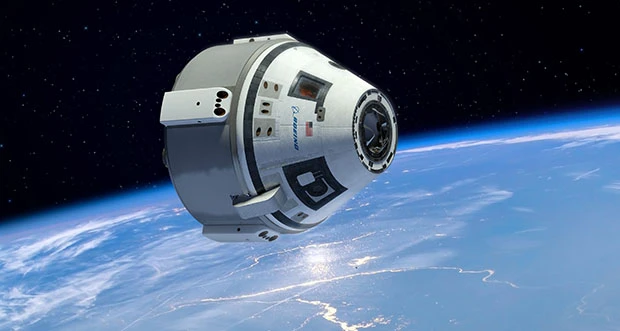
Houston – Boeing recently completed the Phase Two Spacecraft Safety Review of its Crew Space Transportation (CST)-100 spacecraft and the critical design review (CDR) of its integrated systems, meeting all of the company’s Commercial Crew Integrated Capability (CCiCap) milestones on time and on budget.
The reviews were Boeing’s final two milestones in the current phase of its partnership with NASA. Completed in July, the CDR milestone marks a significant step in reaching the ultimate design that will be used for the spacecraft, launch vehicle, and related systems. Propulsion, software, avionics, landing, power, and docking systems were among 44 individual CDRs conducted as part of the broader review.
“The challenge of a CDR is to ensure all the pieces and sub-systems are working together,” said John Mulholland, Boeing Commercial Crew program manager. “Integration of these systems is key. Now we look forward to bringing the CST-100 to life.”
The CST-100 is being developed as part of NASA’s Commercial Crew Program, which aims to make crew transportation systems available for low-Earth orbit destinations such as the International Space Station by 2017. The capsule could accommodate up to seven crew members or a mix of crew and cargo and features a weld-less structure, wireless Internet, and Boeing LED “Sky Lighting” technology.
The Phase Two Spacecraft Safety Review included an overall hazard analysis of the spacecraft, identifying life-threatening situations and ensuring that the current design mitigated any safety risks.
Source: Boeing Defense, Space & Security