Airbus and Boeing Co. are bitter rivals, but Canadian plane maker Bombardier Inc. has united them in opposing its plans for funding sales of a new jetliner. The flap has prompted many of the world's richest countries to meet next week to revisit an earlier agreement that set rules on aircraft-financing deals.
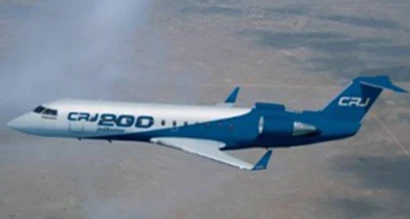
The fight is over a new aircraft from Bombardier that is bigger than the propeller planes and regional jets that the Montreal-based company has made before and which will compete with models from industry giants Boeing of the U.S. and Airbus of Europe.
Canada has proposed financing the plane on advantageous terms permitted for smaller jets, but not for most Airbus and Boeing airliners. Canada says it is free to do so under current international rules.
The U.S., which is supporting Boeing, and the European Union, which is backing Airbus, don't agree with that interpretation. Canada's proposal "really doesn't hold any water," said Fred Hochberg, chairman of the U.S. Export-Import Bank, a government agency that helps fund Boeing sales. "I think it's a threat to American jobs," Mr. Hochberg said.
Finance officials representing plane makers from Brazil, Japan, Russia and China are also likely to weigh in when talks to resolve the dispute and redefine export-financing rules for the industry begin Feb. 1 at the Organization for Economic Cooperation and Development in Paris.
A spokesman for Canada's Finance Department said his government "fully supports" efforts to resolve the dispute.
The tussle may be one of a series of similar headaches for Boeing and Airbus, a unit of European Aeronautic Defence & Space Co., which for more than a decade have split world-wide sales of passenger jets with more than 100 seats.
Both companies value their combined market at more than $3 trillion over the next 20 years. But the duo are starting to face competition from around the world as small-plane makers offer slightly larger models.
Jet maker Sukhoi of Russia, Mitsubishi Heavy Industries Ltd. of Japan and a group of Chinese aerospace companies are developing new planes that will seat at least 100 passengers, spurred by a desire to extend their product lines as well as reduce their country's dependence on foreigners Boeing and Airbus.
Brazil's Empresa Brasileira de Aeronáutica SA, or Embraer, already has a plane that seats as many as 100 people.
Bombardier, previously known for so-called regional jets, which generally seat up to 90 people, is developing a new jet family, called the CSeries that will seat up to 150 passengers. That would pit it directly against smaller versions of Boeing's 737 and Airbus's A320 models.
Airbus and Boeing initially brushed off the competitive threat from Bombardier and other newcomers to their market. The two giants have long argued that airlines enjoy big savings in such areas as training pilots and buying spare parts when they buy the bulk of their planes from one supplier, such as Boeing or Airbus, whose aircraft range in size from around 100 seats to more than 500.
But the two companies joined forces last summer when Bombardier proposed financing the CSeries using favorable export-credit terms permissible only for regional jets.
"If there's one thing Airbus and Boeing can agree on, it's this," said Airbus Chief Operating Officer John Leahy.
"Bombardier's position clearly would be a distortion of competition." Boeing officials concurred.
A Bombardier spokesman said that, in approving the financing terms, the Canadian government followed existing rules.
Export credit is a type of government-backed financing that most countries offer to foreign buyers of their products or services. It normally involves an export-credit agency guaranteeing to a bank that the buyer—such as an airline—will repay a loan. If the buyer defaults, the agency repays the bank and pursues the defaulter for reimbursement.
Airplane buyers are major users of export credit because one jetliner can cost more than $200 million. To avoid competing on export subsidies, governments from the home countries of Boeing and Airbus agreed in 1986 on basic rules that set limits on the scope of their support, such as duration and interest rates.
The goal was to create a level financial playing field that would force Airbus and Boeing to battle primarily on their products' merits.
In recent years, as Bombardier and Brazil's Embraer started selling more regional jets, governments world-wide decided they needed to expand the agreement. In July 2007, after nearly three years of talks, they signed a new pact, called the Aircraft Sector Understanding.
Negotiators failed to agree on common financing terms for all planes, and instead established one set of terms for Airbus and Boeing and more-favorable rules for regional jets. Officials at Boeing and Airbus say they didn't mind because the two markets didn't overlap.
Last year, however, Bombardier began aggressively marketing the CSeries as an alternative to Boeing and Airbus jets, and the Canadian government told the OECD it wanted to classify the plane as a regional jet.
Airbus and Boeing cried foul.
Attempts to classify the CSeries "clearly demonstrated the limitations of the ASU," the Bombardier spokesman said.
OECD officials aim to reach a new deal this year, hoping to overcome the current pact's shortcomings. A U.S. Treasury spokeswoman said the goal is "a single set of financial rules for all aircraft models."
An EU spokeswoman said the 27-country bloc is "currently in the process of formulating its positions," which will require haggling inside the EU because its member countries make both regional jets and Airbus planes.
Industry officials said they have proposed a compromise for all sizes of jetliners through a trade association, the Aviation Working Group. The plan, which remains confidential, will be one proposal on the table when talks start next month.
Latest from Aerospace Manufacturing and Design
- Archer to test Starlink onboard its Midnight air taxis
- System eliminates cage-creep in sliding bearings
- Bodo Möller Chemie signs worldwide supply contract with Airbus
- Sandvik Coromant's CoroTurn Plus turning adapter
- ZOLLER Technology Days & Smart Manufacturing Summit May 13-14, 2026 in Ann Arbor, Michigan
- Walter's TC620 Supreme multi-row thread mill family
- ThermOmegaTech achieves CMMC Level 2 C3PAO certification
- One-touch precision flex locators