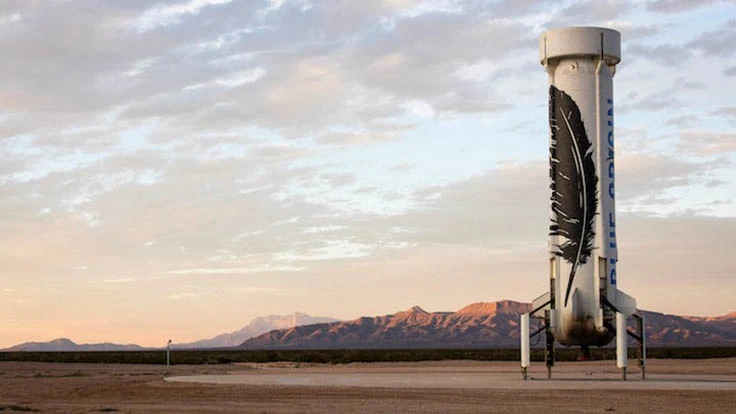
Van Horn, Texas – Blue Origin’s New Shepard space vehicle successfully flew to space, reaching its planned test altitude of 329,839ft (100.5km) before executing a historic landing back at the launch site in West Texas on Nov. 23, 2015.
“Now safely tucked away at our launch site in West Texas is the rarest of beasts – a used rocket,” said Amazon founder Jeff Bezos and owner of Blue Origin LLC, a private company developing vehicles and technologies to enable commercial human space transportation. “Blue Origin’s reusable New Shepard space vehicle flew a flawless mission – soaring to 329,839ft and then returning through 119mph high-altitude crosswinds to make a gentle, controlled landing just four and a half feet from the center of the pad. Full reuse is a game changer, and we can’t wait to fuel up and fly again.”
Named in honor of the first American in space, Alan Shepard, the New Shepard vertical takeoff and vertical landing vehicle will carry six astronauts to altitudes beyond 100km, the internationally-recognized boundary of space.
Blue Origin astronauts will experience the thrill of launch atop a rocket, the freedom of weightlessness, and views through the largest windows to ever fly in space. Astronaut flights will begin following completion of a methodical flight test program.
The New Shepard space vehicle is comprised of two elements: a crew capsule in which the astronauts ride and a rocket booster powered by a single American-made BE-3 liquid hydrogen, liquid oxygen engine. At liftoff, the BE-3 delivers 110,000 lb of thrust. During ascent, astronauts experience 3x the force of gravity as the spacecraft accelerates through the atmosphere.
Following powered flight, the crew capsule separates from the booster and coasts into space, providing several minutes of weightlessness. As the crew capsule descends, it reenters the atmosphere with astronauts experiencing about 5x the force of gravity before deploying three main parachutes for landing. Meanwhile, the booster descends under guided flight to the landing pad. Just prior to landing, the booster re-ignites its BE-3 engine which slows the vehicle to 4.4mph for a gentle, powered vertical landing, enabling vehicle reuse.
Flight details
- Launched at 11:21am CST, Nov. 23, 2015
- Apogee of 329,839ft (100.5km) for the crew capsule
- Mach 3.72
- Re-ignition of rocket booster at 4,896ft above ground level
- Controlled vertical landing of the booster at 4.4mph
- Deployment of crew capsule drogue parachutes at 20,045ft above ground level
- Landing of the crew capsule under parachutes at 11:32am CST
Source: Blue Origin
Latest from Aerospace Manufacturing and Design
- Archer to test Starlink onboard its Midnight air taxis
- System eliminates cage-creep in sliding bearings
- Bodo Möller Chemie signs worldwide supply contract with Airbus
- Sandvik Coromant's CoroTurn Plus turning adapter
- ZOLLER Technology Days & Smart Manufacturing Summit May 13-14, 2026 in Ann Arbor, Michigan
- Walter's TC620 Supreme multi-row thread mill family
- ThermOmegaTech achieves CMMC Level 2 C3PAO certification
- One-touch precision flex locators