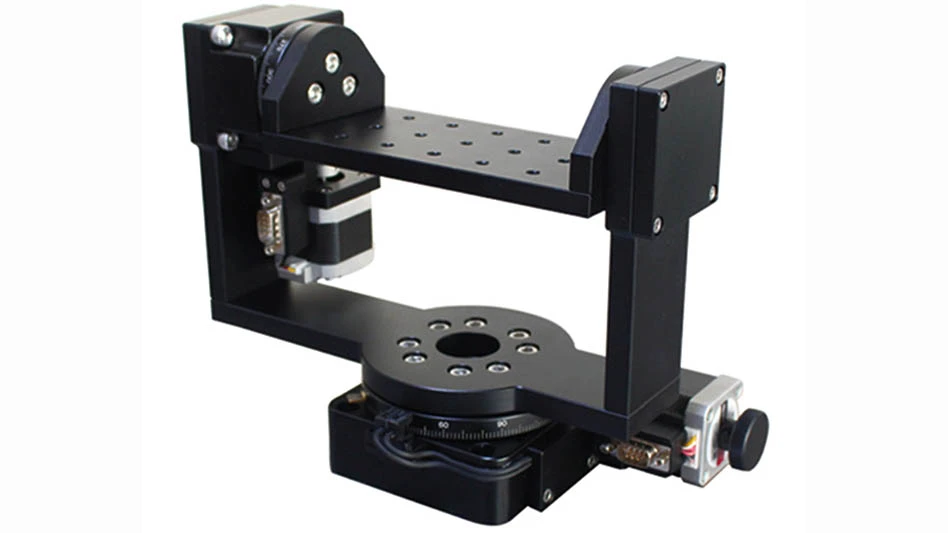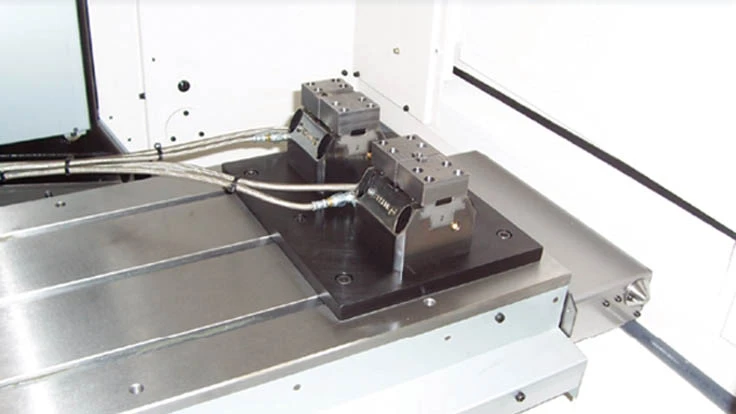
A very important aspect of a successful automation cell is automated workholding. Most lathes come standard with this provision; however, this feature will normally need to be added to most milling machines and EDMs.
The first choice is the power system to control the workholding. The most popular workholding controls are hydraulic, pneumatic, and vacuum.
Pneumatics are normally lighter duty and are typically considered when attempting to hold small or delicate parts.
Vacuum, although much less popular, is a good choice when doing thin plate work when it is not clamping on the outside of the blank. It has the ability to offer several different holding options on a single vacuum plate, allowing for little or no setup between several jobs.
Read more of Part 3 of 3 here.
The first choice is the power system to control the workholding. The most popular workholding controls are hydraulic, pneumatic, and vacuum.
Pneumatics are normally lighter duty and are typically considered when attempting to hold small or delicate parts.
Vacuum, although much less popular, is a good choice when doing thin plate work when it is not clamping on the outside of the blank. It has the ability to offer several different holding options on a single vacuum plate, allowing for little or no setup between several jobs.
Read more of Part 3 of 3 here.
Latest from Aerospace Manufacturing and Design
- Archer to test Starlink onboard its Midnight air taxis
- System eliminates cage-creep in sliding bearings
- Bodo Möller Chemie signs worldwide supply contract with Airbus
- Sandvik Coromant's CoroTurn Plus turning adapter
- ZOLLER Technology Days & Smart Manufacturing Summit May 13-14, 2026 in Ann Arbor, Michigan
- Walter's TC620 Supreme multi-row thread mill family
- ThermOmegaTech achieves CMMC Level 2 C3PAO certification
- One-touch precision flex locators