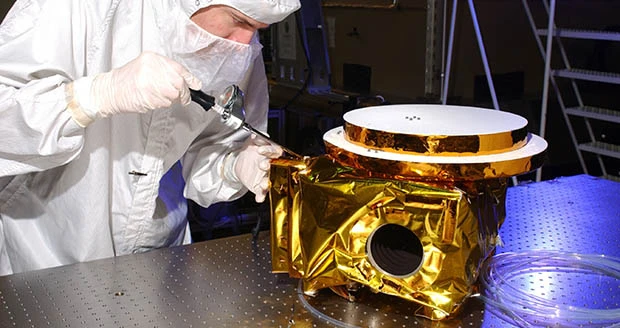
Boulder, Colorado – The Ball Aerospace & Technologies Corp. Ralph camera aboard the New Horizons mission will provide the closest images ever seen of Pluto when the spacecraft arrives at the dwarf planet on July 14, 2015.
Ralph, the main "eyes" of New Horizon is designed to help scientists map the surface geology of Pluto and its moons, and investigate Kuiper Belt objects. The small but powerful Ralph weighs only 23 lb and operates on approximately 7W, the power of a standard night light. The entire telescope operates around 220K (-60°F) in the cold darkness of the outer solar system. After a journey of more than nine years, Ralph will capture the first ever close-up snapshots of Pluto when New Horizons passes within 7,000 miles of the tiny, icy dwarf planet.
"We know so little about Pluto that we expect the mission to help answer questions we haven't even thought to ask," said Jim Oschmann, vice president and general manager for Ball's Civil Space and Technology business unit. "The powerful digital imaging capabilities built into Ball's Ralph instrument will help reveal the mysterious worlds in the third zone of our solar system for the first time."
One of seven core instruments, Ralph is not an acronym, but instead is named after TV character Ralph Kramden of the 1950s sitcom, "The Honeymooners." A visible/near multi-spectral and short wavelength infrared spectral imager, Ralph – like the TV character – is paired with Alice, an ultraviolet imaging spectrometer that will help us learn more about Pluto's atmosphere.
Launched on the New Horizons spacecraft in 2006, Ralph consists of three panchromatic (black-and-white) and four color imagers with telescopic resolution 10x better than the human eye. Ralph will take images twice daily as New Horizons approaches, flies past, and then looks back at the Pluto system. Following its main objective to observe Pluto, New Horizons will continue cruising through space at about 35,000mph, passing through the Kuiper Belt where some 70,000 objects pepper the Kuiper Belt with potential observation targets.
At the time New Horizons was launched, scientists knew about one of Pluto's moons – Charon.
But using Hubble Space Telescope images taken with cameras built by Ball Aerospace, scientists have discovered four more: Nix, Hydra, Styx, and Kerberos.
The New Horizons spacecraft was built for NASA by Southwest Research Institute and Johns Hopkins Applied Physics Laboratory. The mission's principal investigator is SwRI's Alan Stern.
Ball Aerospace & Technologies Corp. received the order, developed, and delivered Ralph for launch within 22 months.
Source: Ball Aerospace & Technologies Corp.
Latest from Aerospace Manufacturing and Design
- Archer to test Starlink onboard its Midnight air taxis
- System eliminates cage-creep in sliding bearings
- Bodo Möller Chemie signs worldwide supply contract with Airbus
- Sandvik Coromant's CoroTurn Plus turning adapter
- ZOLLER Technology Days & Smart Manufacturing Summit May 13-14, 2026 in Ann Arbor, Michigan
- Walter's TC620 Supreme multi-row thread mill family
- ThermOmegaTech achieves CMMC Level 2 C3PAO certification
- One-touch precision flex locators