Farnborough, England – Alcoa and and United Technologies Corp.’s Pratt & Whitney have agreed to a 10-year, $1.1 billion agreement for jet engine components.
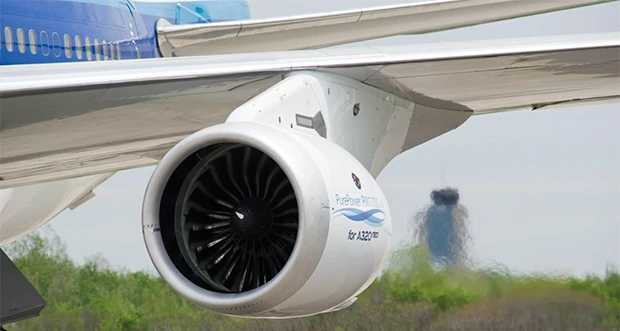
Under the deal, signed at the Farnboroguh Air Show, Alcoa will supply key parts for Pratt & Whitney engines, including the forging for the first-ever aluminum fan blade for jet engines. The forging, developed for Pratt & Whitney’s PurePower engines, use an advanced aluminum alloy.
The PurePower is designed with a special architecture that allows for aluminum alloys to be used in its fan blades. The lighter material makes the engine lighter, more fuel efficient, and more cost efficient. Pratt & Whitney says the engine will power some of world’s highest volume aircraft, including the next-generation Airbus A320neo.
“We’re going where no materials scientist has gone before,” said Klaus Kleinfeld, chairman and CEO of Alcoa, “Combining Alcoa’s proprietary alloys and unique manufacturing processes with Pratt & Whitney’s design, we cracked the code on forging an aluminum fan blade that is lighter and enables better fuel efficiency.”
According to the agreement, Alcoa will supply components for the PurePower PW1000G, V2500, GP7000, and other regional jet and military engines.
“Through our novel engine design, and by working with industry leaders such as Alcoa, we are able to provide our customers with double-digit improvements in fuel efficiency, environmental emissions and noise. The PurePower engine’s hybrid metallic fan blade represents a significant advance in our engine design and allows us to meet engine performance requirements while reducing weight and cost,” said Paul Adams, president, Pratt & Whitney.
Pratt & Whitney’s advanced gear system allows the fan to rotate at a slower speed and the hot section to operate at higher speeds, optimizing the running conditions of both. The large, light-weight fan moves more than 90% of the air around the core, delivering a very quiet engine with very low fuel burn. The larger fan diameter also opened the door to materials beyond titanium and composites.
Alcoa plans to use aluminum and aluminum-lithium from its Pittsburgh, Pennsylvania and Lafayette, Indiana facilities for the front fan blades, which will be produced using proprietary manufacturing processes at its Cleveland, Ohio plant. Several of Alcoa’s facilities including La Porte, Ind.; Whitehall, Mich.; Dover, N.J.; and Wichita Falls, Texas, will supply the blades, vanes and structural components, produced using nickel-based superalloys, titanium as well as aluminum.
Source: Alcoa
Latest from Aerospace Manufacturing and Design
- The Lee Company opens Innovation Center
- Precision XY gantry system
- Archer to test Starlink onboard its Midnight air taxis
- System eliminates cage-creep in sliding bearings
- Bodo Möller Chemie signs worldwide supply contract with Airbus
- Sandvik Coromant's CoroTurn Plus turning adapter
- ZOLLER Technology Days & Smart Manufacturing Summit May 13-14, 2026 in Ann Arbor, Michigan
- Walter's TC620 Supreme multi-row thread mill family